Safe Postpartum Exercises for the First 6 Weeks

Quick Answer: In the first 6 weeks after birth, safe exercise means diaphragmatic breathing, gentle pelvic floor reconnection, short slow walks, and easy stretching — nothing more. Get your provider’s clearance first, start with 5 minutes a day, and stop immediately if you notice pain, increased bleeding, or pelvic heaviness. Healing is the goal in this window, not fitness.
The early weeks with a newborn are a blur of feeds, naps that don’t happen, and a body that feels borrowed. “Exercise” sounds like a word from someone else’s life.
But gentle movement — the genuinely gentle kind — helps circulation, mood, and recovery. The catch is that almost every postpartum article skips straight to core workouts, and this window isn’t for that.
Here’s what’s actually appropriate in the first 6 weeks, and the warning signs that mean you’ve done too much.
Why Is Recovery the Priority in the First 6 Weeks?
Because your body is still doing enormous internal work that you can’t see.
The uterus is shrinking back toward its pre-pregnancy size, which takes roughly 6 weeks. Connective tissue that stretched over nine months is slowly recovering its tension. If you had a cesarean, there’s a surgical incision healing through multiple layers. If you had a vaginal birth, there may be tearing or stitches doing the same.
None of that is helped by intensity, and all of it can be set back by it. Pushing too early is the most common reason people end up with pelvic floor problems that take months rather than weeks to resolve.
So the frame for this window is reconnection, not training. You’re re-establishing the signal between your brain and the muscles that carried a pregnancy — a slower, quieter project than it sounds.
Always get your healthcare provider’s clearance before starting anything, including walking. And let how you feel lead, not a calendar. Rest here isn’t the opposite of progress; it is the progress.
What Movement Is Actually Safe Right Now?
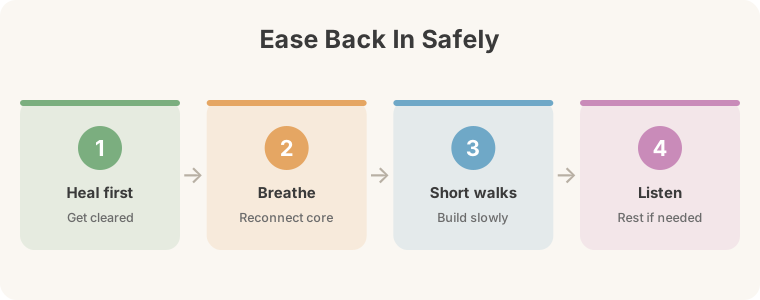
Four things, in roughly this order. Start with 5 minutes total per day and build only when it feels genuinely easy.
1. Diaphragmatic breathing
Lie down or sit supported, one hand on your ribs and one on your belly. Breathe in so the ribs widen sideways, then let everything soften on the exhale. Two minutes, a few times a day.
This is the quiet foundation for everything that comes later. Your diaphragm and pelvic floor work as a pair, and re-teaching that rhythm is genuinely the most useful thing you can do in week one.
2. Gentle pelvic floor reconnection
Once cleared, try a very light lift on the exhale — the sensation of stopping gas, not a maximum squeeze — held for 3 seconds, then a full release. 5 to 8 repetitions, once or twice a day.
The release matters as much as the lift. A pelvic floor that can’t relax is just as problematic as one that can’t contract.
3. Short, slow walks
Start with 5 to 10 minutes at a genuinely conversational pace. Around the block counts. Circulation, daylight, and a change of scenery do real work for mood and healing alike.
Add a few minutes only when the previous distance felt effortless — and skip the hills for now.
4. Easy stretching
Feeding, rocking, and carrying a newborn all pull you forward into the same rounded posture for hours a day. Gentle neck rolls, a doorway chest opener held 20 seconds per side, and a slow upper back stretch undo some of that.

What Nobody Tells You About Postpartum Movement
Six weeks isn’t a finish line. The postpartum check-up is a checkpoint, not a starting gun. Plenty of people aren’t ready for higher-impact movement at 6 weeks, and that’s completely normal rather than a sign of falling behind.
Cesarean recovery is surgical recovery. It follows a different timeline, and abdominal work in particular needs specific clearance. Walking is usually fine early; anything that engages the incision line is not.
Feeling “fine” isn’t the same as being healed. Adrenaline, sleep deprivation, and sheer determination are excellent at masking fatigue. The symptoms below are more honest than how you feel in the moment.
Bleeding is a usable signal. Lochia that lightens and then gets heavier again after activity is a fairly direct message that you did more than your body was ready for. Scale back for a few days.
And the comparison trap is real. Recovery timelines vary enormously between people and between births — including between your own first and second. Someone else’s week-four run says nothing about yours.
When Should You Stop and Call a Professional?
Stop the activity and check in with your provider if you notice:
- Any sharp pain, anywhere
- Increased bleeding or a return to heavier flow after it had lightened
- A feeling of heaviness, dragging, or pressure in the pelvis or vagina
- Leaking urine during movement
- A visible doming or coning down the center of your abdomen
- Exhaustion beyond the ordinary depths of new-parent tiredness
These aren’t failures. They’re your body giving you information, and honoring them without guilt is the whole skill of this stage.
A pelvic health physiotherapist is worth seeing if any of the above persists, and in many countries is worth seeing routinely — they can assess pelvic floor function and abdominal separation properly rather than by guesswork.
Mini FAQ
When can you start exercising after giving birth?
Gentle breathing and short walks are often appropriate within the first days or weeks, but only with your provider’s clearance. Structured exercise usually waits until after the 6-week check-up, and longer after a cesarean or a complicated birth.
Are ab exercises safe in the first 6 weeks?
Crunches, planks, and sit-ups are not recommended this early. They load a healing abdominal wall and can worsen separation. Breathing and gentle pelvic floor work are the appropriate “core” work in this window.
How long should postpartum walks be at first?
Start at 5 to 10 minutes on flat ground at a pace where you could hold a conversation. Increase only when that length feels genuinely easy, and pull back if bleeding increases afterward.
TL;DR:
- The first 6 weeks are for healing and reconnection, not fitness.
- Safe: diaphragmatic breathing, gentle pelvic floor work, short flat walks, easy stretching.
- Start at 5 minutes a day and build only when the current amount feels effortless.
- Stop for pain, increased bleeding, pelvic heaviness, leaking, or abdominal doming.
- Get provider clearance first, and consider a pelvic health physio for a proper assessment.
You just did the hardest thing your body will ever do. Let strength come back on its own schedule — it will.
Gentle postpartum walking is the easiest place to start, and comfortable high waist leggings with a soft, non-binding waistband make those first short walks a lot less annoying on a tender midsection.
This article is for general informational purposes only and isn’t medical advice. Always consult your healthcare provider before exercising postpartum.
See It in Motion
Seen here: Maternity Capris with Side Pockets — shop it on bubblelime.com
Keep Reading
This article is for general informational and styling purposes only. Fit, sizing, and product availability may vary.