Can You Do Planks After Birth? A Realistic Progression
Quick Answer: Planks can be a useful part of postpartum core training, but most new moms do better building up through easier positions first. Your starting point depends on how you delivered, how your core responds to coughing or lifting, and whether you have diastasis recti. Start with breathing and modified holds, and move forward only when your form stays steady.
Your friend posted a plank challenge, and you thought, “Sure, how hard can it be?” Then you tried one on the living room rug, and your belly bulged like a loaf of bread. You’re not failing. That bulge is one of the most useful signals your body can give you, and it tells you exactly where to begin.
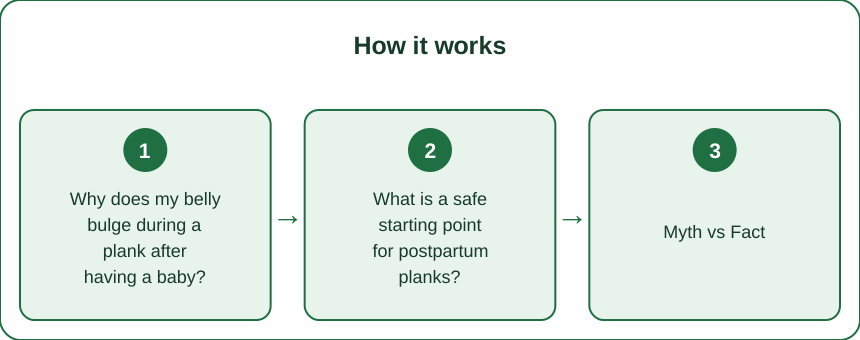
Why does my belly bulge during a plank after having a baby?
During a plank, your deep abdominal wall has to hold your organs in place while your arms and legs push against the floor. After months of pregnancy, that wall was stretched and then reset with a new load every day, so it often needs time to regain its tension.
When pressure has nowhere to go, it pushes outward along the midline of your belly. Doming or a ridge down the center is a sign to drop the difficulty, not push through the hold. Most moms see this clearly in a mirror or with a quick hand check.
If you notice leaking when you laugh or sneeze, a heavy feeling low in your pelvis, or pain in your lower back during holds, talk to your provider before adding more planks.
What is a safe starting point for postpartum planks?
Think of planks as a ladder, and climb one rung at a time:
- Rung 1: Exhale breathing. Lie on your back, knees bent, and breathe out slowly while you gently lift your pelvic floor.
- Rung 2: Counter plank. Hands on a kitchen counter, step back until your body forms a straight line. Hold 20 seconds.
- Rung 3: Knee plank. Forearms or hands on the floor, knees down, hips in line with shoulders. Hold 15 to 20 seconds.
- Rung 4: Forearm plank from knees. Hold 20 seconds, then rest.
- Rung 5: Full forearm plank. Only after rung 4 stays steady for a week.
Aim for 3 sets of 15 to 20 seconds, 3 days a week. Breathe out on effort, keep your ribs down, and stop the set the moment your belly starts to dome.
Myth vs Fact: You Need a Strong Core Before Any Plank
Myth: You have to build strength first, and only then can you start planks.
Fact: The plank is one of the ways you build core strength. You don’t need to be strong to start, you need to be able to hold good form for a short time. Starting on your knees or against a counter is not cheating. It’s the same movement at a level your body can manage today.
Most moms find that a short, steady hold done three times a week builds noticeable control within four to six weeks, and the holds get longer without the belly bulge.
FAQ: Postpartum Planks, Answered
Are planks safe after a C-section?
They can be, but timing and position matter. Many providers want you to get clearance before adding more core work, and an incline or counter plank is usually the gentlest place to start. Follow your provider’s guidance on when to move on.
How often should I practice?
Three days a week is a solid target for most moms. Rest days still count for walking and breathing work, and steady practice beats long, forced sessions.
When should I see a professional?
See a pelvic floor physical therapist if you have ongoing doming, pelvic heaviness, leaking, or pain that doesn’t ease with rest. Early help is far easier than fixing a problem that has been building for months.
This is general information, not medical advice.
TL;DR:
- Planks are a ladder you climb one rung at a time, not a test you pass on day one.
- Start on a counter or your knees, and end the set the moment your belly starts to dome.
- Aim for 3 sets of 15 to 20 seconds, 3 days a week.
- Get checked if you notice leaking, pelvic heaviness, or ongoing pain.
Your core is rebuilding on its own timeline, and steady, small holds beat a fast start every time.
See It in Motion
Seen here: Maternity Capris with Side Pockets — shop it on bubblelime.com
Keep Reading
This article is for general informational and styling purposes only. Fit, sizing, and product availability may vary.