When Kegels Are Not Working: A Complete Postpartum Troubleshooting Guide

Quick Answer: Kegels commonly fail postpartum for six reasons: you’re contracting the wrong muscles, you’re never fully releasing, the pelvic floor is overactive rather than weak, breathing pressure is working against you, the dosage is too low, or there’s a structural issue like significant prolapse or scar tissue that exercise alone won’t resolve. The most common single cause is an overactive floor being strengthened when it needs releasing - which makes symptoms worse, not better.
Six months of daily squeezes and you still leak when you sneeze. It’s a genuinely common story, and the reflexive advice - do more of them - is wrong often enough to be worth taking seriously.
This is general information, not medical advice. A pelvic health physiotherapist can assess in one appointment what no article can, and that assessment is the single highest-value step in this entire guide.

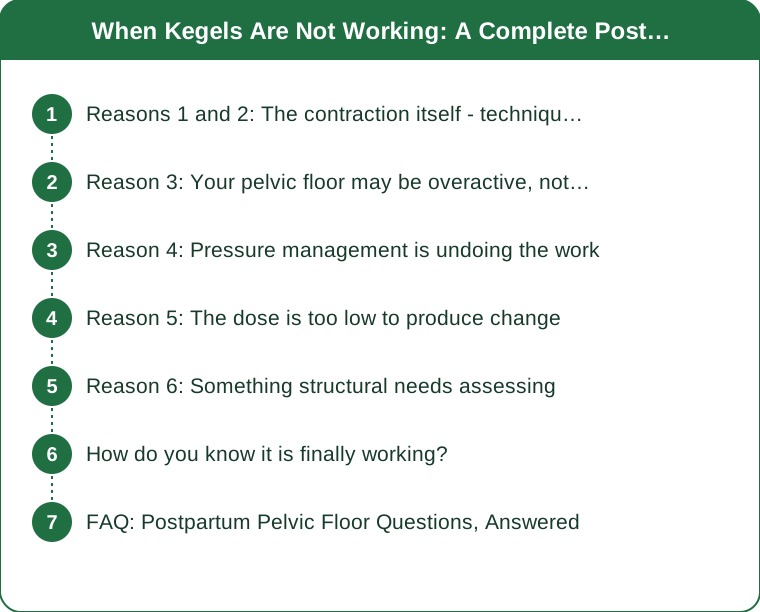
Reasons 1 and 2: The contraction itself - technique and release
Reason 1: You may not be contracting the pelvic floor at all
This is the most common finding when people are assessed, and it’s not a matter of trying harder.
Studies of women given only verbal instruction on pelvic floor contraction find a substantial proportion perform it incorrectly - most often by bracing the abdominals, squeezing the glutes, gripping the inner thighs, or bearing down instead of lifting. Bearing down is the most concerning of these, because it’s the exact opposite of the intended action and can worsen symptoms over months of practice.
What a correct contraction feels like: a gentle lift and inward draw, as though you were stopping the passage of wind and slowing a stream of urine at the same time. The sensation is internal and upward. Your buttocks shouldn’t visibly tighten, your thighs shouldn’t move, and your belly shouldn’t harden or push outward.
Three self-checks:
- Hand on the belly. Contract. If the abdominal wall pushes out into your hand, you’re bearing down rather than lifting.
- Mirror check. Sitting on the edge of a chair with a mirror below, a correct contraction produces a visible inward and upward movement. This is uncomfortable to do and it is genuinely diagnostic.
- Breath check. If you have to hold your breath to produce the contraction, you’re recruiting the wrong system.
The important caveat: self-checks confirm an obviously wrong pattern but can’t confirm a correct one. If any doubt remains after two weeks of practising the checks, an internal assessment by a pelvic health physiotherapist resolves in ten minutes what months of guessing won’t.
Reason 2: You are contracting but never fully releasing
A muscle that never returns to its resting length loses both strength and endurance. The pelvic floor is no exception, and release is the half of the exercise that almost never gets coached.
Most people count the squeeze and ignore the letting go. The result over months is a floor that lives in a permanently shortened state - which produces exactly the symptoms people associate with weakness: leaking, urgency, heaviness, and pain.
How to build release into the practice:
- Match the timing. A 5-second hold needs a 5-second release - actively noticed, not just stopped.
- Exhale to contract, inhale to release. The diaphragm and pelvic floor move together. Inhaling naturally lengthens the floor; using that helps you find a release you can’t produce voluntarily.
- Notice what a full release feels like. Most people describe a distinct softening or widening. If your contraction and your rest feel similar, you’re not fully releasing.
A practical test: perform ten repetitions. If repetitions 8, 9 and 10 feel easier than the first three, you’re likely not returning to baseline in between - the muscle is staying partly on, so there’s less distance to travel.
Adding proper release to an existing practice sometimes resolves symptoms with no increase in strength work at all. It’s the cheapest intervention in this guide and the most frequently skipped.
Reason 3: Your pelvic floor may be overactive, not weak
This is the one that turns months of diligent work into worsening symptoms, and it’s underdiagnosed.
An overactive - or hypertonic - pelvic floor is one that’s holding too much tension at rest. It produces symptoms that look identical to weakness from the outside: urinary urgency, leaking, a feeling of heaviness, and difficulty fully emptying. Strengthening an overactive floor is like doing bicep curls for a cramp.
Signs that point toward overactivity rather than weakness:
- Pain with penetration, tampon use, or a smear test
- A constant feeling of tightness, aching, or pressure in the pelvis
- Difficulty starting urination, or a slow or interrupted stream
- Constipation and straining
- Symptoms that got worse after you started doing more kegels
- High general muscle tension, clenched jaw, or a history of significant stress or anxiety
What to do instead if this sounds like you: stop the strengthening work and switch to downtraining - diaphragmatic breathing, supported child’s pose, happy baby, deep squats with support, and warmth. Give it three to four weeks and reassess.
This is the specific scenario where a professional assessment is not optional advice but the actual answer. An overactive floor and a weak floor need opposite programmes, and you cannot reliably tell which you have from symptoms alone.
Reason 4: Pressure management is undoing the work
Your pelvic floor is the base of a pressurised canister - diaphragm on top, abdominal wall in front, back muscles behind, floor underneath. Strengthening one wall while the pressure system pushes downward means you’re working against yourself all day.
Where the pressure goes wrong in daily postpartum life:
- Breath-holding during lifting. Picking up a toddler, a car seat, or a laundry basket with a held breath drives pressure straight down onto the floor. This happens dozens of times a day.
- Straining on the toilet. Constipation is extremely common postpartum, and each straining episode is a heavy downward load.
- Coughing without preparation. Postnatal coughs, seasonal colds, and allergy season all deliver repeated high-pressure events.
- Traditional sit-ups and crunches performed too early, which bulge the abdominal wall forward and press downward.
The corrections:
- Exhale on effort. Blow out as you lift. Say it out loud if it helps - blow before you go - and apply it to every single lift, not just heavy ones.
- Use a footstool on the toilet to bring knees above hips, and don’t strain. Address constipation directly with fibre, fluid, and if needed a clinician’s help.
- Brace before a cough or sneeze - a quick pelvic floor lift a moment before is called the knack, and it’s well-supported for reducing leaking.
The daily pressure load is far larger than any exercise programme. If it’s working against you for sixteen hours a day, ten minutes of exercise won’t outrun it.

Reason 5: The dose is too low to produce change
If technique and pressure are genuinely in order, the next candidate is simple volume. Pelvic floor muscle is skeletal muscle and it responds to progressive overload like any other.
What research-backed programmes typically look like: three sets per day, 8 to 12 maximal contractions per set, held for 6 to 8 seconds each, with equal rest between - continued for at least 12 to 16 weeks.
Compare that to what most people actually do: a handful of squeezes at traffic lights, inconsistently, for a few weeks. That’s not a failed programme - it’s an untested one.
Building the dose without it taking over your life:
- Anchor to existing routines. One set at each feed, or one set at each nappy change, or morning/lunch/evening. Anchoring beats remembering.
- Include both quick and slow contractions. Slow holds build endurance; quick flicks of 1 second build the fast-twitch response that catches a sneeze. Most programmes need both. Ten quick flicks after each set of long holds is sufficient.
- Progress the position. Start lying down, then progress to sitting, then standing, then during movement. Standing is significantly harder than lying - if you’ve been doing all your work in bed, you have a whole progression still available to you.
- Expect a 12-week horizon. Meaningful change at 6 weeks is possible, but 12 to 16 is the realistic window. Judging a programme at week 3 is the most common reason people abandon one that was working.
Reason 6: Something structural needs assessing
Exercise resolves a great deal, and there are situations where it isn’t the complete answer. Knowing which is which prevents both unnecessary worry and unnecessary delay.
Worth a professional assessment now, not in six months:
- A visible or palpable bulge, or a persistent feeling of something coming down - this may be prolapse, which is common, treatable, and graded. Many cases respond very well to conservative management, and some benefit from a pessary. Knowing the grade changes the plan.
- Significant diastasis recti - a gap wider than roughly two to three finger-widths, or a doming that persists. The abdominal wall and pelvic floor work as one system, and a deficit in one limits the other.
- Scar tissue from a caesarean, a tear, or an episiotomy that’s tethered or painful. Scar tissue mobilisation is straightforward, effective, and rarely offered unless you ask.
- Pain of any kind - during exercise, during sex, or persistent pelvic pain. Pain is information, and it changes the programme.
- Symptoms that are getting worse despite consistent, correct work.
The honest framing: postpartum pelvic health follow-up in most healthcare systems is a single brief appointment, and pelvic floor function is rarely examined in it. Finding a pelvic health physiotherapist is something most people have to initiate themselves. If you take one action from this article, make it that appointment - it converts six months of guessing into a specific plan.
And there’s no expiry date on this. Assessment and treatment help whether you’re 8 weeks postpartum or 8 years.
How do you know it is finally working?
Progress in pelvic floor rehabilitation is rarely dramatic, which is why so many people quit a programme that was actually working. Knowing what the early markers look like keeps you in it long enough to reach the obvious ones.
Early signs, weeks 2 to 6:
- You can find the contraction more easily and hold it longer before it fades
- You can do it without holding your breath
- The release feels distinctly different from the hold
- Standing contractions become possible, not just lying ones
Middle signs, weeks 6 to 12:
- Fewer leaks in the situations that used to be reliable triggers - the sneeze, the trampoline, the run for the bus
- Less urgency, and more warning before you need a toilet
- Reduced heaviness at the end of the day
Later signs, weeks 12 and beyond:
- Symptoms absent in situations that previously triggered them every time
- Confidence to return to running or higher-impact training
Track it simply. A note on your phone once a week - leaks this week, heaviness out of 10, one thing that felt easier. Weekly beats daily; daily tracking makes normal fluctuation look like failure.
One realistic expectation: symptoms often vary with your cycle, with fatigue, and with how much you’ve been carrying that week. A bad week inside an improving trend is not a failed programme - which is precisely why the weekly note matters more than how you feel today.
FAQ: Postpartum Pelvic Floor Questions, Answered
Is it too late if I’m years postpartum?
No. Pelvic floor muscle responds to training at any point postpartum, and people see meaningful improvement starting five, ten, or twenty years later. The timeline is similar - 12 to 16 weeks of consistent work.
Do the apps and trainers with sensors help?
Biofeedback devices genuinely help with one specific problem: knowing whether you’re contracting correctly. If your issue is technique, they’re useful. If your issue is that your floor is overactive, they can reinforce exactly the wrong pattern - which is why assessment should come first.
Can I run again, and when?
Most guidance suggests returning to running no earlier than 12 weeks postpartum, and only once you can manage impact without leaking or heaviness. A useful screen: 30 seconds of jogging on the spot, 10 single-leg hops per side, and 20 bodyweight squats with no symptoms.
Does a second or third baby reset all of this?
Each pregnancy loads the system again, but the strength and technique you build genuinely carry forward. Women who train the floor between pregnancies typically recover faster afterwards, and the work is never wasted.
TL;DR:
- The most common cause of failed kegels is incorrect technique - including bearing down instead of lifting
- Release is half the exercise; match release time to hold time and inhale to let go
- An overactive floor needs downtraining, not strengthening - strengthening it makes symptoms worse
- Daily pressure management (exhale on effort, footstool, the knack before a cough) outweighs the exercise programme
- The effective dose is 3 sets of 8-12 holds daily for 12-16 weeks, progressing from lying to standing
- Bulge, significant diastasis, painful scar tissue, or worsening symptoms all warrant assessment now
If months of effort haven’t changed anything, the answer is almost never more effort. It’s usually a different exercise, a different pressure habit, or an assessment that tells you which of the two problems you actually have. One appointment with a pelvic health physiotherapist reliably outperforms another six months of guessing.
See It in Motion
Seen here: Maternity Capris with Side Pockets — shop it on bubblelime.com
Keep Reading
This article is for general informational and styling purposes only. Fit, sizing, and product availability may vary.