Postpartum Training When Childcare Is the Actual Limit, Not Your Body

Quick Answer: If your postpartum training keeps stalling, the bottleneck is usually scheduling rather than healing. Standard progressions assume 45 to 60 uninterrupted minutes, and almost nobody has that in the first year. The fix is to rebuild the same progression in 8 to 12 minute blocks, keep the weekly total roughly constant, and accept interruption as part of the design rather than as failure. Two or three short blocks a day reach the same weekly volume as one long session and are far more likely to actually happen.
You are not unmotivated and your core is not broken. You have been handed a plan written for someone with a free hour, and you have eleven minutes.

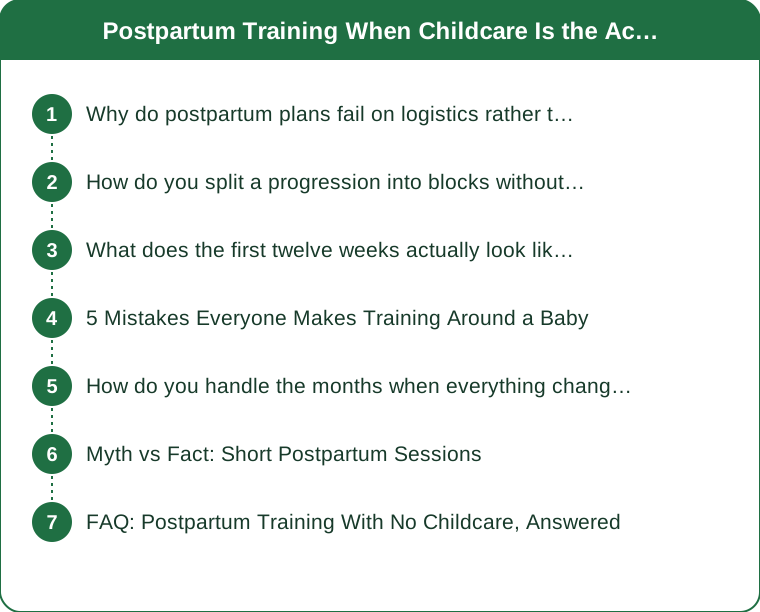
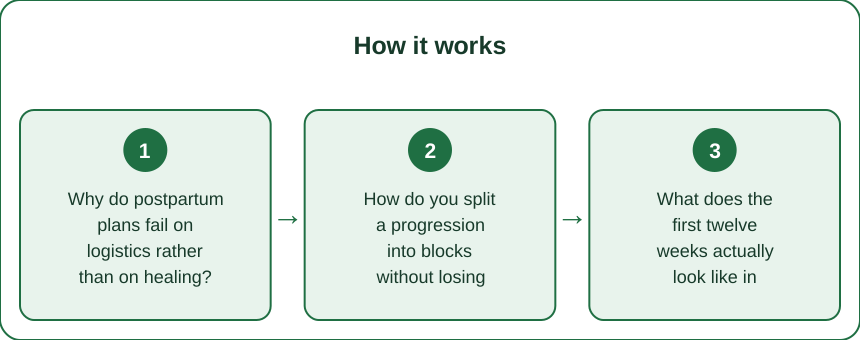
Why do postpartum plans fail on logistics rather than on healing?
Because nearly every published progression is written around a session, not around a day. Week four says twenty minutes of walking plus a core circuit. Week eight says thirty minutes of strength. The unit of measurement is a block of protected time, and protected time is precisely the resource that a newborn removes.
The result is an all-or-nothing pattern. If a session needs 40 minutes and you have 12, the plan offers no instruction for what to do with the 12. So the 12 minutes go unused, the week records a zero, and the next week starts with the same plan and the same shortfall.
Then the missed weeks get read as a body problem. This is the expensive misreading. Six weeks of not training gets interpreted as my core is not recovering, when the honest description is that no training happened. The two produce identical-looking results and require completely different responses.
Meanwhile the physical readiness is often ahead of the schedule. Tissue healing after an uncomplicated vaginal birth is largely complete by around twelve weeks, and much of the connective tissue remodelling continues quietly for months after that regardless of what you do. Many people are cleared and capable well before their calendar cooperates.
And the mismatch compounds through the first year. Sleep is broken, feeds are unpredictable, naps shorten around four months and again around eight, and any plan that requires a fixed daily window will collide with every one of those transitions. A plan that does not require a fixed window survives them all.
The reframe that fixes it: stop asking when can I train and start asking what fits in the gap I actually have. The gap is real, repeatable, and usually between eight and fifteen minutes. Build there.
How do you split a progression into blocks without losing the progression?
Keep the weekly volume as the unit, not the session. If a plan calls for 90 minutes of strength work a week, that is nine ten-minute blocks or six fifteen-minute blocks. The tissue does not know how the week was divided; it responds to total load and to frequency, and frequency actually improves when you split.
Assign each block one job. A block that tries to be a full workout in twelve minutes becomes a rushed circuit and teaches you nothing. A block with one job - lower body pushing, or breathing and core connection, or a loaded carry - is finishable, and finishable is the whole point.
Rotate the jobs across the week rather than within the day. Monday morning block is hips. Monday evening block is upper back. Tuesday morning is core connection. You are building a week that adds up rather than a session that gets abandoned at minute six.
Repeat movements far more often than a conventional plan would. Doing a hip hinge four times a week for three sets is not overtraining at this load, and the repetition is what rebuilds the motor pattern that pregnancy and months of asymmetric carrying disrupted. Frequency is genuinely your advantage here.
Progress by adding a block before adding difficulty. The first upgrade is five blocks a week instead of four. The second is six. Only after the frequency is stable do you add load or complexity, because adding difficulty to an unstable schedule reliably produces a week off.
And keep one honest record: blocks completed per week. Not minutes, not perceived effort, not weight. A number you can count on your fingers on Sunday evening, which either went up, held, or went down, and tells you what to do next without any interpretation.
What does the first twelve weeks actually look like in blocks?
Weeks one to three: two to four blocks a week, eight minutes each, all of it breathing and gentle reconnection. Diaphragmatic breathing on your back, side-lying, then seated. Pelvic floor contractions coordinated with the exhale rather than held randomly. Slow, unloaded glute bridges. If you had a caesarean, add gentle scar-adjacent skin mobilisation only once fully healed and cleared, usually around six to eight weeks.
Weeks four to six: four to five blocks, ten minutes, adding walking as its own block. A ten-minute walk counts as a block. Two of them count as two. This is the point where most people discover they have been waiting for a thirty-minute walk that will never materialise while ignoring three separate ten-minute ones that already exist in their day.
Weeks seven to nine: five blocks, ten to twelve minutes, introducing load. Bodyweight squats to a chair, hip hinges holding a single weight, supported rows, and carries - a shopping bag in one hand walked around the house counts and is genuinely useful for reintroducing trunk stiffness under load.
Weeks ten to twelve: five to six blocks, twelve minutes, adding one slightly harder thing per week. Step-ups. A split squat holding the counter. Rows with a band anchored under a door. Still nothing that requires setup time exceeding about ninety seconds, because setup time is what kills a block.
Across the whole period, one non-negotiable: if you have any leaking, heaviness, dragging in the pelvis, or pain, that is a signal to stop progressing and get assessed by a pelvic health physiotherapist. This is general information, not medical advice, and symptoms like these are common but not something to train through.
And one thing to deliberately skip: timed challenges, anything measured against a pre-pregnancy number, and any movement you are dreading. None of them are load-bearing in a plan whose entire purpose is to survive contact with an unpredictable day.

5 Mistakes Everyone Makes Training Around a Baby
Mistake one: waiting for the good window. The good window is the one where the baby naps long, you are not exhausted, and the house is calm. It arrives about once a fortnight. Everything built on it collapses. Build on the mediocre window instead - the one that shows up daily and is only eleven minutes long.
Mistake two: setup that takes longer than the block. If the mat lives in a cupboard, the weights live upstairs, and the video needs finding, the twelve-minute block is really a twenty-minute block and you will not start it. Leave the mat down. Leave one weight in the living room. Ugly, but functional, and functional is the standard here.
Mistake three: treating an interrupted block as a failed block. You will get four minutes in and be needed. Four minutes happened. Come back if you can, do not if you cannot, and record it as a block. A plan that punishes interruption is a plan that will be abandoned by week three.
Mistake four: doing core work as a separate project. Splitting the day into a workout and then some core work doubles the number of windows you need. Fold the breathing and pelvic floor coordination into the first thirty seconds of every block instead. It gets done daily, which is what actually matters for reconnection.
Mistake five, and the one that catches almost everybody: benchmarking against your pre-pregnancy self. It is a comparison against a person with different sleep, different hormones, different tissue, and crucially, unlimited scheduling freedom. The useful comparison is against last week, measured in blocks completed. That is a number that moves, and moving numbers are what keep people training.
How do you handle the months when everything changes again?
Around four months, naps shorten and become less predictable. The plan that depended on a reliable long nap breaks here, and a lot of people quietly stop. The response is to shift blocks to times that are not nap-dependent: first thing before the day starts, or during floor play where the baby is on a mat beside you.
Around six to eight months, mobility arrives and floor work gets complicated. A baby who moves will crawl onto you mid-plank. This is genuinely funny for about two days. Switch the majority of blocks to standing work - squats, hinges, carries, step-ups - which is better training for real life anyway, and keep only the breathing work on the floor.
When you return to paid work, the day compresses but becomes more predictable. Trade one longer block for two shorter ones anchored to fixed times, usually before leaving and immediately after the evening handover. Predictability is worth more than duration, and a fixed time slot survives fatigue better than a flexible one.
When sleep is genuinely broken, reduce intensity but keep frequency. On very poor sleep, drop the load and keep the block - walking, mobility, breathing. The purpose on those days is maintaining the habit, not producing adaptation. Training hard on badly disrupted sleep produces poor sessions and worse recovery, so there is nothing lost in easing off.
And when a whole week disappears, restart at the previous week’s block count, not from the beginning. Detraining across seven days is negligible. The instinct to restart from week one after a missed week is the single most common reason a postpartum progression takes a year to cover twelve weeks.
Myth vs Fact: Short Postpartum Sessions
Myth: short workouts do not build strength. Fact: total weekly volume drives most of the strength adaptation, and volume distributed across more frequent short sessions performs comparably to the same volume in fewer long ones for beginners and returning trainees. What short sessions cost you is the long-duration conditioning work, which is not the priority in the first year anyway.
Myth: you need to fully warm up, so anything under twenty minutes is wasted. Fact: a general warm-up matters most before heavy or ballistic work. For chair squats, hinges with a light weight, and carries, two or three progressively heavier sets of the movement itself is a sufficient warm-up and takes ninety seconds.
Myth: core recovery requires dedicated core sessions. Fact: breathing coordination, loaded carries, and controlled squats and hinges all train the trunk under exactly the conditions daily life demands. Isolated core work has a place, but the belief that it must be separate is what makes people skip it entirely.
Myth: if you cannot do it properly, it is not worth doing. Fact: the standard for the first year is consistent and symptom-free, not perfect. A slightly scrappy hip hinge done four times a week beats a pristine one done twice a month, provided nothing hurts and nothing leaks.
Myth: you will get back to it when things settle down. Fact, and this is the one worth sitting with: things settle into a different shape, not into a spare hour. Four months brings different constraints, not fewer. The plan that works is the one designed for the constraints you have now.
FAQ: Postpartum Training With No Childcare, Answered
How long should postpartum workouts be?
Eight to twelve minutes per block, two or three blocks a day, is a realistic and effective structure for the first year. What matters is the weekly total and the frequency, not the length of any single session, so four ten-minute blocks a week is a genuine training week rather than a compromise.
Can I exercise with my baby in the room?
Yes, and for most people it is the only version that happens consistently. Keep the baby on a mat within sight, choose standing movements once they start moving, and use equipment that cannot roll or fall toward them. Expect interruption and treat a partial block as a completed one.
When can I start strength training after giving birth?
Most guidance places gradual return to resistance work from around six weeks after an uncomplicated birth, later after a caesarean or any complication, and always after clearance. Start with bodyweight and carries rather than loaded barbell work, and stop progressing immediately if you notice leaking, pelvic heaviness, or pain - those warrant assessment by a pelvic health physiotherapist. This is general information, not medical advice.
Is it too late to start if my baby is already six months old?
No. Connective tissue remodelling continues well beyond the first year, and strength and core function respond to training whenever you begin. Starting at six or twelve or eighteen months follows the same block progression - the only adjustment is that a mobile baby pushes you toward standing work sooner.
TL;DR:
- Most postpartum plans fail on scheduling, not healing - they assume a protected 45-minute window that the first year does not contain.
- Rebuild the same progression in 8 to 12 minute blocks, keep weekly volume constant, and give each block exactly one job.
- Count blocks completed per week as your only metric; progress by adding a block before adding difficulty.
- Expect the plan to break at four months, at crawling, and at return to work - shift the timing, do not restart the progression.
- After a missed week, resume at the previous block count rather than starting over.
- Any leaking, heaviness, or pain means stop progressing and get assessed, not push through.
The eleven minutes you already have, four times a week, will get you further this autumn than the perfect hour that keeps not arriving.
See It in Motion
Seen here: Maternity Capris with Side Pockets — shop it on bubblelime.com
Keep Reading
This article is for general informational and styling purposes only. Fit, sizing, and product availability may vary.