Postpartum Hip and Pelvis Mobility (Gently Restoring How You Move)

Quick Answer: Hips and pelvis feel different after birth because pregnancy changed how they were loaded for months, ligament laxity lingers, and carrying a baby on one hip creates real asymmetry. Short, frequent mobility work helps more than long occasional sessions — 5–10 minutes of hip circles, pelvic tilts, hip flexor lengthening and glute activation, most days. Stop for pain or any heaviness, and see a pelvic health physio if you can.
You’re eight months out. The baby sleeps (mostly), you’ve been cleared for ages, and your body has technically “recovered.”
But your right hip is tighter than your left. Mornings feel stiff in a way they never used to. And by the end of a day spent carrying a toddler on one side, something low in your back is complaining.
That’s not in your head, and it’s not permanent. It’s a loading problem, and loading problems respond well to being addressed.

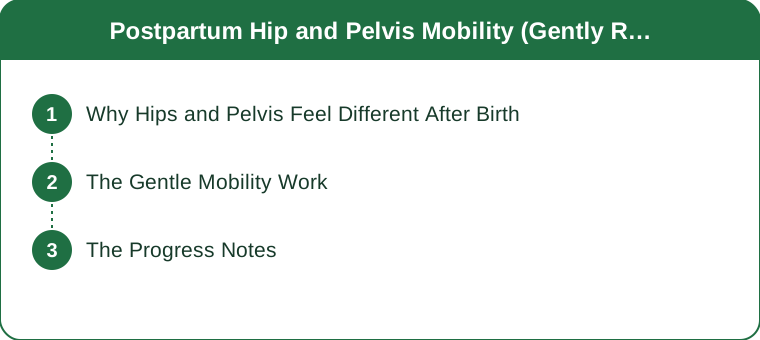
Why Do Your Hips and Pelvis Feel Different After Birth?
Five things changed, and they compound:
Pregnancy altered how the pelvis was loaded — for months. Your centre of gravity moved forward, your pelvis tilted, and your body adapted by changing which muscles worked and which switched off. Delivery ends the pregnancy; it doesn’t undo nine months of altered movement patterns.
Ligament laxity lingers past delivery. The hormonal changes that loosened your pelvic ligaments for birth don’t switch off the moment the baby arrives. That looser feeling can persist for months, and often longer while breastfeeding.
Carrying creates genuine asymmetry. Most people have a default hip. Sit a baby on it for eight months and you’ve effectively done a very long, very one-sided training program — tight on one side, weak on the other.
There’s simply less general movement. Feeding, sitting, holding, more sitting. Hips stiffen from position, not just from damage.
The pelvic floor and hips are one system. They share attachments and they share the job of managing pressure. Tightness or weakness in one shows up in the other, which is why hip work and pelvic floor work belong together.
The reframe: postpartum hips are genuinely changed — and gentle mobility work addresses more of it than most people expect.

What Mobility Work Actually Helps?
Eight things. You don’t need all of them daily — pick 4 or 5 and do them often.
1. Hip circles and pelvic rocking. On hands and knees or standing: slow circles through the hip, then rocking the pelvis forward and back. 10 each direction. The gentlest possible way to remind the joint it has a full range.
2. Hip flexor lengthening. Half-kneeling, back knee down, tuck the tailbone under slightly and shift forward until you feel the front of the hip. Hold 30 seconds each side. Months of sitting and feeding shorten these.
3. Glute activation. Glutes commonly stop firing properly after pregnancy, and the surrounding muscles pick up the slack badly. Glute bridges, 2 sets of 12, squeezing at the top for a full second. This is the highest-value item on the list.
4. Adductor and inner thigh mobility. Gentle wide-knee rocking or a supported butterfly. 30–60 seconds. Easy does it — these can be tender.
5. Pelvic tilts. Lying on your back, knees bent, gently flattening and arching the lower back. 10 slow reps. This rebuilds the awareness and control that pregnancy blurred.
6. Side-lying hip work. Clamshells and side-lying leg lifts load the glute medius — the muscle that stabilises your pelvis when you stand on one leg, which is what walking is. 2 sets of 12 each side.
7. Breath coordinated with the movement. Exhale as you contract or lift, inhale as you release. This links the diaphragm and pelvic floor with the hip work rather than training them separately.
8. Walking as the base. None of the above replaces regular gentle walking. Twenty minutes most days is the substrate everything else sits on.
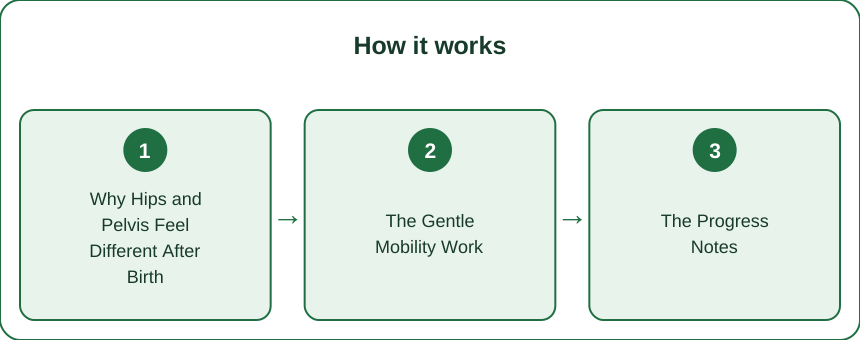
What Nobody Tells You About Postpartum Hip Recovery
Short and frequent beats long and occasional. Five to ten minutes most days does more than a 45-minute session on Sunday. Tissue responds to frequency. Also, you have a baby — 5 minutes is a plan that survives contact with reality.
Stretching a tight hip sometimes makes it worse. If a muscle is tight because it’s compensating for a weak glute, stretching it repeatedly doesn’t fix anything. Strengthen first, stretch second — that’s why glute activation is on the list before the stretches.
The asymmetry is fixable, but only if you address the cause. Consciously alternate which hip you carry on. Use both sides for the car seat. Switch feeding positions. Mobility work can’t out-run eight hours a day of one-sided loading.
Hip work and pelvic floor work belong together. Doing one without the other leaves results on the table. If you’re doing pelvic floor rehab, add the hip mobility; if you’re doing hip mobility and still leaking, add the pelvic floor work.
The timeline is months, not weeks — and that’s normal, not slow. Pregnancy took nine months, and the recovery of movement patterns runs on a similar clock. You’ll feel small improvements in 2–3 weeks and meaningful ones in 2–3 months.
How Do You Progress Safely?
Start gently and often — short daily sessions before longer ones.
Progress from mobility into strength. Once the range feels comfortable, add load: bodyweight squats, step-ups, then weight. Mobility without strength doesn’t hold.
Two stop signs: pain, and heaviness. Sharp pain anywhere, or a dragging, heavy sensation in the pelvic area, means stop and get assessed. Heaviness in particular can signal prolapse and deserves a proper look, not a wait-and-see.
See a pelvic health physiotherapist if you can. In many places you can self-refer. One session gets you an assessment of your actual asymmetry, pelvic floor and core — far better than guessing from an article.
Be patient with the timeline. Months. Genuinely.
Practical note: floor work is much easier in something that moves with you. High waist leggings with a soft waistband that stays put through bridges and side-lying work — not something that rolls down every time you change position, and nothing that presses on a c-section scar.
FAQ
How long does postpartum hip pain last?
It varies widely, but most women see clear improvement within 2–3 months of consistent mobility and strength work. Ligament laxity can persist for 6–12 months, especially while breastfeeding. Hip pain that’s severe, worsening, or not improving at all with gentle work should be assessed by a physio or your provider.
Can I do hip mobility work while breastfeeding?
Yes — there’s no reason to avoid it. Hormonal laxity may persist while you’re breastfeeding, so progress into loaded movements a bit more gradually and stay attentive to how the joints feel. Many of these exercises can genuinely be done on the floor next to the baby.
Is it too late to fix this if my baby is over a year old?
Not at all. Movement patterns and muscle strength respond to training at any point — one year, three years, ten years postpartum. The asymmetry from carrying is often still active if you’re still carrying a toddler, which means addressing it now is if anything more useful, not less.
TL;DR:
- Hips feel different because of altered loading, lingering laxity, carrying asymmetry and less movement.
- Do 5–10 minutes most days: hip circles, pelvic tilts, hip flexor lengthening, glute activation, side-lying work.
- Strengthen before you stretch — tight often means compensating.
- Alternate which hip you carry on. Mobility work can’t beat all-day one-sided loading.
- Pair it with pelvic floor work; walking is the base under all of it.
- Stop for pain or heaviness. See a pelvic health physio if you can.
- Timeline is months — that’s normal.
See It in Motion
Seen here: Maternity Capris with Side Pockets — shop it on bubblelime.com
Keep Reading
This article is for general informational and styling purposes only. Fit, sizing, and product availability may vary.