Starting Postpartum Core Work a Year (or Five) Later: The Complete Guide

Quick Answer: There is no expiry date on postpartum core recovery. Diastasis recti, pelvic floor weakness, and postural changes from pregnancy respond to targeted work whether you start at 6 weeks or 6 years - the tissue is still adaptable, the progressions are the same, and starting late mostly means you have some compensation patterns to unlearn alongside the rebuilding. Progress is typically slower to feel but no less real.
Everything written about postpartum core recovery assumes you’re reading it in the first twelve weeks. If your youngest is three, or seven, and you’re only now getting to this, the internet acts like you missed something permanent. You didn’t. Here’s the full picture, written for the timeline you’re actually on.

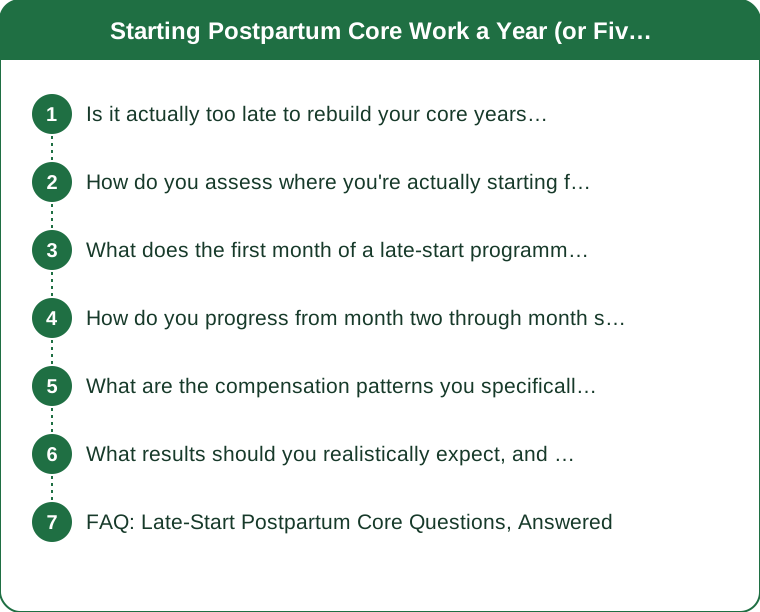
Is it actually too late to rebuild your core years after birth?
No - and the belief that it is has kept an enormous number of people from ever starting.
The idea of a closing window comes from a real observation: the fastest, most dramatic changes in abdominal separation and connective tissue recovery do happen in the first several months, when hormonal and structural changes from pregnancy are still resolving. That’s genuinely a period of rapid change.
But rapid change isn’t the same as the only change. Muscle responds to progressive loading at any age and at any interval after birth. The transversus abdominis, pelvic floor, and deep spinal stabilisers are ordinary skeletal muscle and smooth muscle tissue that respond to training the way muscle always does. The connective tissue of the linea alba - the structure involved in diastasis recti - is slower to remodel, but slower is not fixed.
What genuinely changes with time is the compensation layer. Over years of managing without a well-recruited deep core, you develop movement patterns that work around it: gripping the upper abdominals, holding your breath during effort, standing with your ribs flared and pelvis tipped. These patterns are efficient in the short term and become the main thing standing between you and a functioning deep core.
This means late-start recovery has a slightly different shape than early recovery. Early on, you’re rebuilding capacity in tissue that’s ready to respond. Later, you’re doing that plus unlearning several years of workarounds. It’s more work, but it’s specific, identifiable work rather than a vague deficit.
The practical takeaway: a person starting at year five with consistent, appropriate loading will make real progress. Not the same trajectory as someone starting at week eight, but a genuinely meaningful one - and often with better consistency, since the sleep-deprived newborn phase is behind them.
How do you assess where you’re actually starting from?
Before any programme, you need a baseline. Assessing yourself years later is the same process as assessing at twelve weeks.
The diastasis check. Lie on your back, knees bent, feet flat. Place your fingers just above the navel, pointing toward your feet. Lift your head and shoulders slightly - just enough to feel the abdominals engage. Feel for the gap between the two sides of the rectus abdominis, and note both width (how many fingers fit) and depth (how far your fingers sink before meeting resistance).
Depth matters at least as much as width, and it’s the measure most people skip. A 3-finger gap with firm tension underneath is functionally very different from a 2-finger gap where your fingers sink in with no resistance at all. What you’re training toward is tension, not just narrowness.
Check three points: above the navel, at the navel, and below it. Separation is often uneven, and knowing where yours is worst tells you where to focus.
The breathing check. Lie down, one hand on your ribs and one on your belly. Breathe normally. Does your ribcage expand sideways, or does your chest rise while your belly stays rigid? Restricted lateral rib expansion is extremely common years after birth and is often the first thing that needs addressing, since diaphragm and pelvic floor work as a coordinated system.
The pressure check. Stand up and cough, or stand and lift something moderately heavy. Notice what happens: does your belly dome outward down the midline? Does anything feel like it bulges or drops in the pelvic floor? Doming during effort tells you that intra-abdominal pressure is being managed poorly - which is trainable.
The honest symptom inventory. Write down what’s actually happening: leaking with coughing, sneezing, or jumping; a feeling of heaviness or dragging in the pelvis; back pain that’s worse at the end of the day; a belly that pooches out disproportionately by evening. These are the things you’re actually trying to change, and they’re a better progress measure than any gap measurement.
When to get professional assessment first: any sensation of pelvic organ prolapse (heaviness, bulging, or something feeling like it’s coming down), pain during intercourse, ongoing incontinence, or significant back pain all warrant a pelvic health physiotherapist before starting a self-directed programme. This is general information, not medical advice, and a hands-on assessment catches things a self-check simply can’t.
What does the first month of a late-start programme look like?
The temptation - especially years later, when you feel like you’re behind - is to start with the hard stuff. That’s the fastest way to reinforce exactly the compensation patterns you’re trying to undo.
Weeks 1-2 are almost entirely breathing and awareness. This sounds like nothing and it’s the foundation everything else sits on.
The core exercise is 360-degree breathing: lying on your back, knees bent, hands on your lower ribs. Inhale and aim to feel your ribs expand sideways and backward into the floor, not just your belly rising. Exhale slowly and completely. Do 10 breaths, twice a day.
Once that’s available, add the connection breath: on the exhale, gently draw the pelvic floor up and the lower abdomen inward - about 30% effort, not a maximum squeeze. Inhale and fully release. The release matters as much as the contraction; a chronically gripped pelvic floor is as dysfunctional as a weak one, and gripping is common in people who’ve spent years bracing.
Weeks 3-4 add load in the most controlled positions available. Heel slides (lying on your back, sliding one heel out and back while maintaining the connection breath and keeping your lower back still). Dead bug with just arms. Glute bridges with breath coordination. Each of these for 8-10 slow reps.
The rule that governs everything in this phase: if you see doming down the midline of your abdomen, or you can’t maintain your breathing pattern, the exercise is currently too hard. Regress it. This isn’t a setback - it’s the single most useful piece of feedback available, and it’s why watching your own abdomen during these exercises matters.
What to avoid entirely in month one: crunches, sit-ups, full planks, double leg lowers, and anything that produces visible doming. Not forever - some of these come back later - but they’re a poor starting point when the deep system isn’t recruiting yet.
Realistic time commitment: 10-15 minutes a day. This is genuinely enough at this stage, and a plan you’ll do daily beats a better plan you’ll do twice.

How do you progress from month two through month six?
This is where a late start starts looking like ordinary strength training with a specific emphasis, and where most of the visible change happens.
Months 2-3: adding movement and light load. The goal is maintaining the breath and deep core connection while progressively more is asked of it.
Progressions in rough order: dead bug with opposite arm and leg, side-lying hip work, bird dog, modified side plank from the knees, and squats with attention to breath timing (exhale on the effort). Standing work matters here - a lot of postpartum core programmes stay on the floor far too long, and life happens standing up.
By the end of month three, most people can hold a controlled position for 20-30 seconds with maintained breathing and no doming. That’s the benchmark to progress from.
Months 4-6: real loading. This phase is where the results people actually want tend to appear, and it’s where a lot of programmes stop too early.
Loaded carries are the standout here - a suitcase carry (a single moderately heavy weight in one hand, walking 20-30 metres with ribs stacked over pelvis) trains the deep core against real-world demands more effectively than most floor exercises. Add front-loaded squats, single-leg work, and progressively longer plank variations if they remain symptom-free.
Impact comes last, and only if it’s earned. Running, jumping, and plyometrics belong at the end of this progression, not the start. The readiness test many pelvic health physios use: can you do 10 single-leg heel raises, 10 single-leg bridges, and hop in place for 60 seconds - all without leaking, heaviness, or pain? If not, keep building rather than adding impact.
Expect this to take longer than the internet suggests. A realistic timeline for a late start is 6-12 months of consistent work for substantial change. That’s not a discouraging number when you consider you’ve been managing for years already.
What are the compensation patterns you specifically need to unlearn?
This is the part unique to starting late, and it’s where the extra work lives.
Rib flare and the tipped pelvis. Years of not using the deep core often produces a posture where the ribs sit flared forward and the pelvis tips anteriorly, putting the diaphragm and pelvic floor out of alignment with each other. They function best stacked - roughly, ribs directly over pelvis. Retraining this is a matter of constant low-level cueing rather than a single exercise: notice it standing at the sink, in the school pickup queue, waiting for the kettle.
Upper-abdominal gripping. Many people who’ve had a weak deep core learn to stabilise by permanently holding tension in the upper abs. It works, in that it produces stability, but it drives pressure downward toward the pelvic floor and prevents the deeper system from ever being recruited. The fix is deliberately softening the upper abdomen during breathing work - which initially feels alarmingly unstable.
Breath-holding during effort. Bracing by holding your breath is efficient and extremely common. It also spikes intra-abdominal pressure exactly when you least want it. Retraining to exhale on effort - lifting a child, standing from a chair, pushing a heavy door - is one of the highest-value changes available, and it transfers to hundreds of daily moments.
Asymmetric loading habits. Years of carrying a child on one hip, or sleeping in one position, produce genuine side-to-side differences. Unilateral work - single-leg, single-arm, side-lying - is what addresses this, and it’s frequently missing from generic core programmes.
The one that’s hardest to name: avoidance. Many people years past birth have quietly stopped doing things - jumping on a trampoline, running for a bus, lifting something heavy - and stopped noticing they’ve stopped. Writing down what you’ve been avoiding is often the clearest map of what to work toward.
What results should you realistically expect, and when?
Setting the expectation correctly matters, because unrealistic timelines are the main reason people abandon this at month two.
Weeks 2-4: awareness changes first. You’ll notice your posture, notice when you’re holding your breath, notice doming during effort. Nothing looks different yet. This is normal and it’s the necessary first step.
Weeks 6-12: functional changes. Symptoms often start shifting here - less leaking with a sneeze, less end-of-day back ache, less heaviness. These improvements typically arrive before any visible change and they’re the most meaningful marker that the system is working.
Months 3-6: measurable and visible changes. Diastasis depth commonly improves before width - your fingers meet firm resistance where they used to sink. The abdomen holds better through the day rather than pooching by evening. Strength gains become obvious in loaded work.
Months 6-12: consolidation. Impact activities become available again, if they weren’t. Gains stabilise into something you don’t have to think about constantly.
What might not fully change: some diastasis width may remain, and that’s compatible with a completely functional core - width alone isn’t the outcome measure. Skin laxity doesn’t respond to core training at all, and no exercise programme addresses it. Being clear about this prevents the disappointment that ends otherwise successful programmes.
When to seek help rather than continuing alone: no symptom change after 3 months of consistent work, any worsening of leaking or heaviness, new pain, or a diastasis that seems to be widening. A pelvic health physiotherapist can assess what a self-directed programme can’t see. This is general information, not medical advice.
The honest summary: starting at year five means a longer road with an extra unlearning phase - and a road that leads to essentially the same destination as starting at week six. The window people warned you about was never the one that mattered.
FAQ: Late-Start Postpartum Core Questions, Answered
Can diastasis recti actually close years after birth?
Width may narrow and depth typically improves with consistent work, though full closure isn’t guaranteed at any starting point. Functional improvement - tension across the midline, symptom resolution - is the more realistic and more meaningful goal.
Do I need to see a pelvic health physio, or can I do this alone?
Self-directed work is reasonable if you have no red-flag symptoms. Leaking, heaviness or bulging, pain, or no progress after three months all warrant professional assessment.
Will this change how my stomach looks?
Often somewhat - improved deep core recruitment changes how the abdomen holds through the day. Skin laxity and fat distribution don’t respond to core training, so expectations should be set around function and posture rather than appearance.
Is it safe to do this if I might have another baby?
Yes - entering a subsequent pregnancy with a well-functioning deep core and pelvic floor is generally considered beneficial. Let your care provider know what you’re doing.
How much does age matter if I’m now in my forties or fifties?
Muscle responds to progressive loading at every age. Perimenopausal changes can affect connective tissue and pelvic floor function, which is worth discussing with a doctor, but they don’t remove the benefit of training.
TL;DR:
- There’s no expiry date on postpartum core recovery - the tissue still responds years later
- Late starts have an extra phase: unlearning compensation patterns built over years
- Assess first (diastasis depth, breathing, pressure management, symptoms) before programming
- Start with breath and awareness for 2 weeks, add controlled load, progress to real loading by month 4
- Expect 6-12 months of consistent work for substantial change, with symptom improvement arriving first
- Red flags - leaking, heaviness, pain, no progress at 3 months - mean see a pelvic health physio
The window everyone warned you about was never the one that mattered. This is general information, not medical advice.
See It in Motion
Seen here: Maternity Capris with Side Pockets — shop it on bubblelime.com
Keep Reading
This article is for general informational and styling purposes only. Fit, sizing, and product availability may vary.