Diastasis Recti: Safe Core Moves to Rebuild After Baby

Quick Answer: Start with deep belly breathing, pelvic tilts, heel slides and toe taps — gentle, flat, controlled work that rebuilds the deep core. Skip crunches, sit-ups, planks and twisting ab moves for now. The one rule that governs everything: if your belly domes or bulges down the middle during a movement, stop. That’s pressure on the gap, not healing.
You looked down and there it was — a gap, or a ridge that pops up when you sit forward from lying down.
Meet diastasis recti. It’s extremely common, it’s not a flaw, and it’s not permanent. But how you rebuild matters enormously, because several of the most popular ab exercises make it worse rather than better.
Check with your doctor or a pelvic floor physio before you start.
What Is Diastasis Recti, Exactly?
During pregnancy your growing belly stretches the linea alba — the connective tissue running down the midline between the two halves of your abdominal muscles. That stretching leaves a gap.
Most women have some degree of it right after birth. That’s normal, not a complication.
The goal isn’t to “suck it in.” It’s to gently rebuild deep core strength so the gap narrows and — more importantly — so the tissue across it generates tension again. Function matters more than the number of finger-widths, which surprises most people.
What’s the Number One Rule?
Watch for doming.
During any core movement, look at your belly. If it domes or bulges outward down the middle, that movement is pushing pressure against the gap rather than helping it close. Stop, and come back to it in a few weeks.
What you’re aiming for is the opposite: gentle, deep, flat engagement where the abdominal wall draws inward rather than pushing out. Nothing dramatic should be visible. That’s the point.
Doming is your progression gauge for everything that follows. It’s more reliable than how a movement feels, because diastasis recti doesn’t hurt while you’re making it worse.
Which Moves Are Safe to Start With?
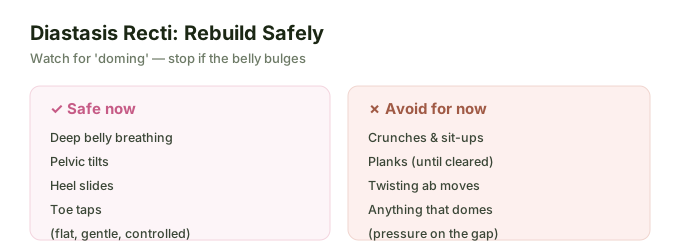
1. Deep Belly Breathing
Lie on your back, knees bent. Inhale and let the ribs expand. Exhale slowly and gently draw your belly button toward your spine. Hold the engagement for 5 slow breaths, then release. Repeat 8–10 times.
This wakes up the transverse abdominis — the deep layer that draws the abdominal wall inward. Start here, every time. It looks like nothing is happening, and it’s the most important exercise on the page.
2. Pelvic Tilts
On your back, gently rock your pelvis to flatten your lower back toward the floor, then release. Small, controlled, 10–12 reps. No lifting, no strain.
3. Heel Slides
On your back with your core gently engaged and flat, slowly slide one heel out along the floor and back. 8 per side. Keep watching the midline — if it domes, shorten the slide.
4. Toe Taps
Legs in tabletop, slowly lower one toe to tap the floor and return. Control beats speed here by a mile. 8 per side, and stop the set the moment the midline changes shape.
Aim for these most days rather than in long sessions — 10 minutes done regularly beats 30 minutes done occasionally.
What Should You Avoid For Now?
These put pressure directly on the gap:
- ❌ Crunches and sit-ups — forward flexion drives pressure outward against exactly the tissue that’s stretched
- ❌ Planks — a heavy demand on the abdominal wall; a progression, not a starting point
- ❌ Twisting ab moves — rotation loads the midline in a way it isn’t ready for
- ❌ Anything that makes your belly dome — including movements not on this list
Note the words “for now.” None of these are banned forever. They’re on hold until the deep layer holds under load — which for most people is a matter of months, not years.
5 Mistakes Everyone Makes
- Going straight back to crunches — the exercise most likely to reinforce the problem, and the one everyone reaches for first.
- Judging progress by how the belly looks — appearance changes with bloating and time of day, and tells you nothing about the tissue.
- Holding the breath during the exercises — breath is the mechanism, not an accompaniment.
- Chasing a gap of zero — tension across the midline matters more than width.
- Treating a support band as the treatment — it’s a helper while you rebuild, not a substitute for the work.
Does Support Wear Help?
A supportive high-waisted legging — or a band recommended by your physio — can give gentle support while you rebuild, and a smooth fit across the midsection makes it easier to actually see whether you’re doming during a movement, which is genuinely useful feedback.
But it’s a helper, not a substitute. The deep-core work is what closes the gap; the support just makes the day more comfortable while it happens.

Frequently Asked Questions
How long does diastasis recti take to heal?
Most women see measurable change over 8–12 weeks of consistent deep-core work, with continued improvement for months after. Connective tissue remodels slowly — check the gap every 3–4 weeks rather than daily, or you’ll frustrate yourself measuring something that moves on a monthly clock.
How do I check my gap at home?
Lie on your back with knees bent, press your fingers gently into the midline just above your navel, and lift your head slightly. Note the width in finger-widths, and how much tension the tissue underneath gives back. Check the same spot the same way each time.
When can I do planks again?
Test rather than guess: hold for 10 seconds and watch your midline. Flat means it’s a reasonable progression. Doming means give it a few more weeks of foundational work. Most people get there, and rushing it is the main reason some don’t.
What if nothing changes after a few months?
That’s the point to see a pelvic floor physiotherapist rather than repeating the same programme. They’ll assess tension across the midline and check your pelvic floor — which usually needs attention alongside the abdominal wall — and tell you whether your approach is right but too gentle, or simply not the right one for your case.
When to See a Professional
See a pelvic floor physiotherapist if you have leaking, pelvic heaviness or pressure, lower back or pelvic pain, a bulge appearing with everyday effort, or a gap that hasn’t improved after a few consistent months. Get medical clearance before starting any of this. Diastasis recti rarely travels alone — pelvic floor function is usually part of the same picture. This article is general information, not medical advice.
TL;DR:
- Diastasis recti is common after birth, not a flaw, and not permanent.
- The governing rule: if your belly domes during a movement, stop — doming is the gauge, not pain.
- Safe starting moves: deep belly breathing, pelvic tilts, heel slides, toe taps. Most days, about 10 minutes.
- Avoid crunches, sit-ups, planks and twisting ab work for now — these are on hold, not banned forever.
- Tension across the midline matters more than closing the gap to zero.
- Support leggings help comfort and visibility; they don’t replace the deep-core work.
See It in Motion
Seen here: High Waist Yoga Leggings with Side Pockets — shop it on bubblelime.com
Keep Reading
This article is for general informational and styling purposes only. Fit, sizing, and product availability may vary.