How to Rebuild Core Strength After Birth (Diastasis Recti Basics)

Quick Answer: Rebuild postpartum core strength by starting with diaphragmatic breathing, pelvic tilts, and heel slides — not crunches or planks, which can worsen diastasis recti in the early months. Progress only when your belly doesn’t cone or dome during a movement. Get checked by a pelvic floor physical therapist before returning to loaded core work.
After giving birth, a lot of people describe feeling oddly disconnected from their middle — like the core they used to have quietly resigned.
That’s normal, and there’s a mechanical reason for it. Rebuilding takes time and, more importantly, the right order. Doing the wrong moves early doesn’t just waste effort; it can slow the healing you’re waiting on.

What Is Diastasis Recti?
During pregnancy the two halves of the rectus abdominis separate along the linea alba — the connective tissue running down the midline — to make room. That separation is diastasis recti, and it’s not a tear or an injury. It’s a normal adaptation that happens to some degree in the large majority of pregnancies by the third trimester.
What varies is how it resolves. Many people see substantial natural narrowing in the first 8 weeks postpartum, with continued improvement over the following months. Some don’t, which is where targeted rehab matters.
The key concept for exercise selection is intra-abdominal pressure. Movements that spike pressure — a crunch, a full plank, heavy lifting with a breath hold — push outward against connective tissue that’s still remodeling. Early on, that pressure is working against you.
A self-check you can do: lie on your back, knees bent. Place your fingers just above your navel, horizontally. Lift your head and shoulders slightly. Feel for a gap and, more importantly, for tension in the tissue. Note whether the midline domes or cones upward. That doming is the signal that a movement is too much right now — it’s more informative than measuring finger-widths, which is a poor predictor on its own.
How Do You Start Rebuilding Postpartum Core Strength?
In this order. Don’t skip ahead because something feels easy.
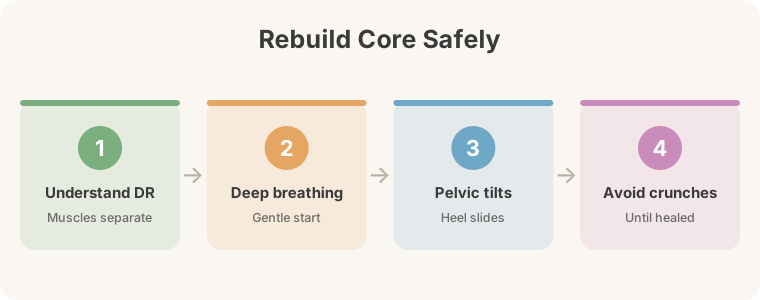
1. Diaphragmatic breathing (start here, week 1+)
Lie on your back, one hand on your ribs, one on your belly. Inhale and let the ribcage expand laterally; exhale slowly and feel the deep abdominal wall draw in gently on its own. 10 breaths, 2–3 times a day. This re-establishes the coordination between diaphragm, pelvic floor, and transverse abdominis — the system that has to work before anything else does.
2. Pelvic tilts
On your back, knees bent, gently flatten your lower back to the floor on an exhale, then release. 10–15 reps. Small, controlled, no breath holding.
3. Heel slides
Same position. Exhale and slide one heel out along the floor, keeping your lower back flat and the midline calm, then return. 8–10 per side. The moment your back arches or your belly domes, you’ve gone past your current range — shorten the slide.
4. Progress with the doming rule
Add toe taps, then single-leg lowers, then bird dogs, then modified side planks. The rule for every progression: if the midline domes or cones, regress. That single check is more useful than any timeline.
What Moves Should You Avoid Postpartum?
Until you’ve healed, been cleared, and can perform them without doming:
- Crunches and sit-ups — the classic pressure spike against the midline
- Full planks — high load on connective tissue that’s still remodeling
- Anything that makes your belly cone, dome, or bulge — the universal stop signal
- Heavy lifting with a breath hold, and intense twisting or rotation
- Double leg lowers and V-sits
None of these are banned forever. Many people return to all of them. It’s a sequencing question, not a permanent restriction — and the ones who progress fastest are usually the ones who spent six patient weeks on breathing and heel slides first.

What Nobody Tells You About the Pelvic Floor
The abdominal wall and the pelvic floor work as one pressure system. You can do everything right for your abs and still struggle if the pelvic floor isn’t part of the plan.
Two things worth knowing. First, leaking urine when you sneeze, laugh, or run is common postpartum and is not something you have to accept — it’s treatable, usually well. Second, pelvic floor dysfunction isn’t always weakness; some people have an over-tight floor that needs relaxation work, and Kegels in that case make things worse.
Which is exactly why a pelvic floor physical therapist is worth seeing rather than guessing. In many countries that assessment is routine postpartum care; in the US it usually isn’t, and you often have to ask for the referral.
When Should You See a Professional?
Book an assessment if:
- A gap of more than about two finger-widths persists past 8–12 weeks postpartum
- You feel a bulge, doming, or coning during everyday activities, not just exercise
- You have urinary or fecal leaking, urgency, or a feeling of heaviness or pressure in the pelvis
- You have ongoing lower back or pelvic pain
- You’re planning to return to running, lifting, or high-impact exercise — this is worth a check even if nothing feels wrong
FAQ
How long does it take to rebuild core strength after birth?
Most people work through gentle rehab over 3–6 months, with the first 6–8 weeks focused almost entirely on breathing and low-load activation. Timelines vary a lot with delivery type, whether it was a first pregnancy, and prior fitness, so progress by symptoms rather than by the calendar.
Can diastasis recti heal on its own?
Often, yes — substantial natural narrowing is common in the first 8 weeks and continues over the following months. When a meaningful gap persists past 12 weeks or there’s ongoing doming and functional weakness, targeted rehab with a pelvic floor physical therapist is what closes the remaining distance.
When can I go back to running after having a baby?
Common guidance suggests waiting until at least 12 weeks postpartum and only after a pelvic floor assessment, since running is high-impact and loads exactly the system that’s still recovering. Returning too early is strongly associated with pelvic floor symptoms, so a clearance is genuinely worth the appointment.
This article is for general informational purposes only and isn’t medical advice. Consult your healthcare provider or a pelvic floor physical therapist before starting postpartum exercise, especially with diastasis recti, a cesarean recovery, or any pelvic floor symptoms.
TL;DR:
- Diastasis recti is a normal pregnancy adaptation; the issue is intra-abdominal pressure during recovery
- Start with diaphragmatic breathing, then pelvic tilts, then heel slides — in that order
- Doming or coning of the midline is the stop signal, and it beats measuring finger-widths
- Avoid crunches, full planks, heavy breath-hold lifting, and twisting until cleared and dome-free
- See a pelvic floor PT before returning to running or lifting, and for any leaking or pelvic heaviness
See It in Motion
Seen here: Maternity Capris with Side Pockets — shop it on bubblelime.com
Keep Reading
This article is for general informational and styling purposes only. Fit, sizing, and product availability may vary.