Diastasis Recti: How to Check It, and What Actually Helps It Close

Quick Answer: Diastasis recti is a widening of the linea alba, the connective tissue between the abdominal muscles, and some degree of it happens in nearly every pregnancy. What matters most is not the width of the gap but whether the tissue can generate tension - a narrow gap that domes under load can be more limiting than a wider one that stays firm. Most cases improve with progressive, tension-focused training over three to six months, and persistent symptoms warrant a pelvic health physiotherapist.
Almost everything written about diastasis is either alarming or dismissive. What follows is the middle: how to check properly, how to read what you find, and how to progress without guessing.

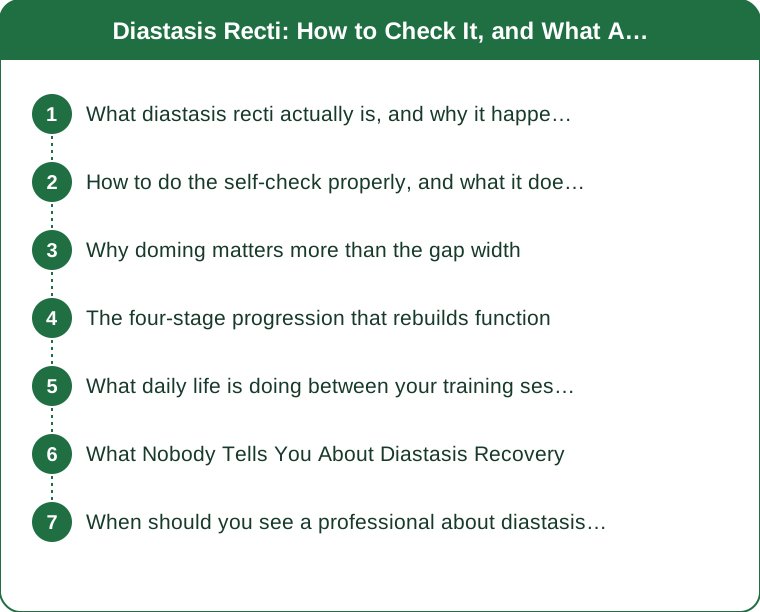
What diastasis recti actually is, and why it happens to nearly everyone
The rectus abdominis - the muscle people call the six-pack - is not one muscle. It is two columns joined down the middle by a band of connective tissue called the linea alba. That band is designed to transmit force between the two sides and to hold the abdominal wall together as a functional unit.
During pregnancy, the growing uterus stretches that band both wider and thinner. This is a normal, necessary adaptation - there is no version of pregnancy where the abdominal wall does not change. Research consistently finds that the large majority of people have measurable separation in the third trimester, and a substantial proportion still have it at eight weeks postpartum.
What varies is the recovery. For many people, the tissue gradually restores tension over the first few months without any specific intervention beyond ordinary activity. For others it does not, and the reason is usually a combination of how the tissue was loaded during pregnancy, how it is being loaded now, and whether the deep system underneath it is participating.
The key reframe: the linea alba is not a wound that closes. It is a tissue that regains or fails to regain its ability to hold tension. That distinction changes everything about how you should train, because you are not trying to pull two edges together. You are trying to restore a system’s ability to generate and transmit force across the midline.
This is also why the number people fixate on - how many fingers wide - is the least informative part of the picture. Two people with an identical two-finger gap can have completely different function, symptoms, and prognosis.
Factors that make separation more likely to persist include multiple pregnancies, larger babies, a short interval between pregnancies, and certain body types. None of these are things you did wrong, and framing it as a personal failure gets in the way of the practical work.
How to do the self-check properly, and what it does and does not tell you
The standard check is simple, but the way most people perform it produces misleading results.
The setup. Lie on your back, knees bent, feet flat, head resting down. Place the fingers of one hand across your midline just above the navel, fingers pointing down toward your feet. Rest them lightly - do not press hard yet.
The movement. Take a normal breath in. On the exhale, lift your head and shoulders just far enough that your shoulder blades barely leave the floor. This is a small movement, not a full sit-up. As you lift, feel along the midline with your fingers.
What to measure, in order of importance:
1. Depth and tension. As you lift, do your fingers sink into a soft valley, or do they get pushed up by tissue that firms under them? Tissue that develops tension and resists your fingers is the good sign - far better than a narrow gap that stays soft and lets your fingers drop in.
2. Width. How many fingers fit side by side at the widest point. Check above the navel, at the navel, and below it, because the gap is rarely uniform.
3. Doming or coning. Watch your midline rather than feeling it. Does a ridge push up along the centre as you lift? That is the tissue being pushed outward by pressure it cannot contain, and it is the single most useful thing you will observe.
What the check does not tell you: it does not diagnose anything, it does not predict how quickly you will recover, and it does not tell you whether you need surgery. It gives you a baseline and a way to notice change over weeks.
Timing matters. Check at the same time of day - abdominal tissue behaves differently in the evening. And do not check daily. Once every three or four weeks is enough to see a trend; checking constantly turns a useful measurement into an anxiety habit.
Why doming matters more than the gap width
If you take one concept from this entire guide, make it this one.
Doming happens when intra-abdominal pressure exceeds what your abdominal wall can contain, and the pressure escapes along the path of least resistance - straight out through the midline. It is a real-time signal that the load you are applying is beyond your current capacity to manage.
This makes doming the most useful training tool you have, because it converts a vague question - is this exercise safe for me - into an immediate, visible answer. If an exercise causes doming, it is currently too much. If it does not, it is currently appropriate. That rule is more accurate than any list of banned exercises, because the right exercise depends entirely on the person and the week.
This is also why blanket lists of forbidden movements are unhelpful. Plenty of people are told never to plank again, when a plank on the knees with good pressure management is exactly the right stimulus for them. Meanwhile someone else domes badly during a simple heel slide, and no list would have flagged that.
How to watch for it properly: train where you can see your midline, at least at first. Bare midriff, or a mirror positioned so you can look down the line of your body. Watch during the hardest part of the movement, which is usually the transition rather than the hold.
Pressure management is the underlying skill. The most common cause of doming in an otherwise capable person is breath-holding and bearing down. Exhaling on the effort - blowing out as you do the hard part - drops intra-abdominal pressure enough that many exercises which domed become clean immediately. Try this before concluding an exercise is off limits.
A second common cause is rib position. Ribs flared upward and outward put the abdominal wall at a mechanical disadvantage. Letting the lower ribs settle down toward the pelvis, without tucking the tailbone hard, changes what the tissue can do.

The four-stage progression that rebuilds function
Progress by capacity, not by calendar. Move to the next stage when the current one is clean - no doming, no bulging, no leaking, no back pain - for a couple of weeks.
Stage 1: Breathing and connection (weeks 1 to 4 of training, whenever you start)
The goal is re-establishing coordination between the diaphragm, the deep abdominal wall, and the pelvic floor. Lie on your back, hands on your lower ribs. Inhale and feel the ribs widen sideways. Exhale slowly through pursed lips and feel the lower abdomen gently draw in on its own - not sucked in forcefully. Ten breaths, twice a day.
Add: gentle pelvic floor engagement on the exhale, released fully on the inhale. Both directions matter; a pelvic floor that cannot relax is as problematic as one that cannot contract.
Stage 2: Low-load limb movement (typically weeks 3 to 8)
Same breathing, now with a small load added. Heel slides, one leg at a time. Toe taps with knees bent at 90 degrees. Single-leg extensions kept high enough that your back stays neutral. Dead bug variations with one limb moving at a time.
Eight to twelve repetitions per side, two to three sets, exhaling on the effort. Watch the midline for every rep. If it domes, reduce the range rather than abandoning the exercise.
Stage 3: Anti-extension and loaded holds (typically weeks 6 to 16)
Now you can add positions that resist the trunk being pulled into extension. Bird dog. Modified side plank from the knees. Front plank from the knees, then progressing to the feet. Standing pallof press with a band. Suitcase carries with a weight in one hand.
These are the exercises that build genuine load tolerance in the linea alba, and skipping straight to them is where people run into trouble.
Stage 4: Return to full training (typically 4 to 6 months onward)
Compound lifts, running, overhead work, and eventually the crunching movements that get demonised. There is nothing inherently wrong with a sit-up - it is a question of whether your abdominal wall can manage the pressure it creates. Many people get back to all of it.
What daily life is doing between your training sessions
You train your core for twenty minutes. You use it for the other fifteen and a half waking hours, and that is where a lot of the outcome is decided.
How you get out of bed. Sitting straight up from lying is one of the highest-pressure things most postpartum people do, and many do it a dozen times a day with a baby in the picture. Roll to your side, push up with your arm, swing your legs down. This one change often produces more improvement than any exercise, purely through volume.
How you lift the baby, the car seat, and the toddler. Exhale as you lift. Keep the load close. Avoid the twist-and-lift combination when you can. A car seat carried at arm’s length on one side is a genuinely heavy asymmetric load repeated many times daily.
How you stand. The common postpartum posture - ribs flared, pelvis pushed forward, weight hanging on the front of the abdominal wall - loads the linea alba passively all day. Stacking the ribcage over the pelvis is not about rigid posture, just about not resting in the position that stretches the tissue you are trying to restore.
Constipation and straining. Straining generates high intra-abdominal pressure repeatedly. Fibre, fluid, and a footstool under the feet are legitimately part of diastasis management, unglamorous as that is.
Coughing and sneezing. With a cold, that is dozens of high-pressure events daily. Turning to the side and supporting the abdomen with a hand or a pillow measurably reduces the load.
Carrying and feeding positions. Long periods held in a collapsed, rounded position with the baby resting on the abdomen keep the tissue in a lengthened, unsupported state. Use cushions to bring the baby up to you rather than folding down to the baby.
What Nobody Tells You About Diastasis Recovery
The gap may never fully close, and that can still be a complete success. The functional goal is tissue that generates tension and an abdominal wall that manages pressure. Many people end up with a measurable but firm gap, no symptoms, and full return to the activities they care about. Chasing the number past that point is chasing the wrong target.
Progress is not linear, and it is worse in the evening. Abdominal tissue behaves differently after a long day, especially after eating. A check at 9pm will look worse than the same check at 8am, and neither is the true version.
Sleep deprivation genuinely affects connective tissue recovery. This is not an excuse, it is a reason to be patient with a timeline that is being run under difficult conditions.
Very few people need surgery, and the ones who do usually know why. Persistent pain, a hernia, significant urinary symptoms, or a functional limitation that has not moved after months of good rehab are the reasons to have that conversation. Cosmetic appearance alone is a personal decision, not a medical necessity.
The third point catches even careful people: doing more is not better. Twice-daily gentle work beats one long, hard session, because connective tissue responds to consistent moderate load and reacts badly to occasional excessive load. The people who progress fastest are usually the ones doing ten focused minutes most days.
And breath-holding is the most common single error. Not the exercise choice, not the timeline - just holding the breath during effort. Fixing that alone resolves a surprising amount.
When should you see a professional about diastasis recti?
Self-directed work is appropriate and effective for many people. It is not appropriate for everyone, and knowing where the line is saves months.
See a pelvic health physiotherapist promptly if you have:
- Urinary or faecal leaking, urgency, or difficulty emptying
- A feeling of heaviness, dragging, or bulging in the pelvis or vagina
- Pain during intercourse
- Persistent low back or pelvic girdle pain
- A visible bulge along the midline that appears at rest, not only under load
- Any suspicion of a hernia, particularly a firm lump at or near the navel
- No change at all after three months of consistent, appropriate work
What an assessment involves. A history, an external abdominal assessment including the tension check done properly, an assessment of your breathing and pressure management, usually an internal pelvic floor examination with your consent, and a movement screen. You leave with a specific programme rather than a generic one.
Why it is worth it even if you are doing fine. A single session can tell you whether the deep system is actually engaging, which is nearly impossible to verify on your own. Many people discover they have been doing the breathing work with a pelvic floor that never releases, which caps progress regardless of effort.
On timelines: meaningful change usually shows over three to six months of consistent work, and continued improvement well past a year is normal. If you are two years postpartum and just starting, that is fine - connective tissue remains responsive to load. There is no window that closes.
This article is general information and not medical advice. Postpartum recovery varies enormously between individuals, and a professional who can actually assess you will always beat a guide that cannot.
FAQ: Diastasis Recti Questions, Answered
Can diastasis recti close completely?
Sometimes, but full closure to zero is not the standard for success and not what most people achieve. Restoring tension across the midline, resolving symptoms, and returning to full activity are the meaningful outcomes, and those are achievable for the large majority.
Are crunches and planks really forbidden?
No. They are inappropriate while they cause doming or bulging, which for many people is early on. Once pressure management is good and the tissue tolerates load, both can return. Judge by what your midline does, not by the exercise name.
Do abdominal binders help?
They can provide short-term comfort and support, especially in the first weeks. They do not close a gap on their own, and relying on one long-term can reduce how much your own system is asked to do. Use as a temporary aid alongside training, not instead of it.
How long should I wait before starting?
Gentle breathing work can usually begin very early with clearance from your provider. Loaded work typically waits until after your postnatal check. If you had a caesarean or complications, the timeline is different and should be individualised.
Does it affect subsequent pregnancies?
A previous diastasis makes another more likely, but going into the next pregnancy with better abdominal wall function generally improves the starting point and the recovery afterward. It is a reason to do the work, not a reason to despair.
TL;DR:
- Diastasis is a loss of tension in the linea alba, not a wound that needs to close
- Depth and tension matter more than how many fingers wide the gap is
- Doming under load is your most reliable real-time signal - it tells you when an exercise is too much today
- Exhale on effort, stack ribs over pelvis, and fix breath-holding before banning exercises
- Progress through four stages by capacity, not calendar: breathing, low-load limb work, anti-extension, full training
- Daily habits - rolling out of bed, lifting, standing, straining - contribute more than the training does
- See a pelvic health physiotherapist for leaking, heaviness, pain, a visible resting bulge, or no change after three months
The most damaging thing about how diastasis usually gets discussed is the implication that there is a deadline. There is not. Connective tissue responds to appropriate, progressive load whether you start at eight weeks or at four years, and the people who do best are almost always the ones doing modest, consistent work while getting the daily-life load right. Start where you are, watch your midline, and let the progression follow your capacity rather than the calendar. This is general information, not medical advice.
See It in Motion
Seen here: Maternity Capris with Side Pockets — shop it on bubblelime.com
Keep Reading
This article is for general informational and styling purposes only. Fit, sizing, and product availability may vary.