Why Your Running Pace Feels Slower in Cool Fall Air After Baby

Quick Answer: Your pace feels slower in cool fall air postpartum because two separate effects are stacking on top of each other. First, cold air is denser and drier than warm air, which increases aerodynamic drag slightly and can trigger mild airway constriction in anyone, postpartum or not — a well-documented effect that alone can add 10-20 seconds per mile at the same effort level. Second, postpartum-specific factors compound it: your diaphragm and deep core canister may still be relearning efficient bracing after pregnancy, and your cardiovascular baseline (blood volume, hemoglobin, aerobic conditioning) is often still rebuilding, especially if you’re breastfeeding or your training volume dropped for months. The combination means the same “hard” effort produces a slower pace than it would either pre-pregnancy or in the middle of summer. This is general information, not medical advice.
If you felt like a completely different runner in September than you did in June, and it’s not just the miles you’ve missed — you’re right to suspect the air itself is part of it. But if you’re also postpartum, the cold-air effect isn’t happening in isolation. It’s landing on a cardiovascular and breathing system that’s already mid-rebuild, and that combination is worth understanding rather than just pushing through.
Why does cold air alone make any runner feel slower?
Cold air is denser than warm air — as temperature drops, air molecules pack more tightly together, which means every stride pushes through slightly more resistance. This effect is small at moderate paces but becomes more noticeable as effort increases, and it’s one reason elite marathon times cluster around cool-but-not-cold race day temperatures rather than warm ones.
There’s a separate, more noticeable effect: airway constriction from cold, dry air. Your airways prefer air that’s warm and humidified by the time it reaches your lungs; breathing in cold, dry air rapidly (as happens during running) can trigger mild bronchoconstriction in people without any diagnosed respiratory condition, not just those with exercise-induced asthma. This shows up as a tighter, more effortful feeling in the chest at a pace that felt easy in summer humidity.
Cold weather also changes your warm-up requirements. Muscle and tendon tissue is viscoelastic, meaning its stiffness is temperature-dependent — colder tissue is stiffer tissue, and stiffer tissue is less efficient at storing and returning elastic energy with each stride. A warm-up that took 5 minutes to feel “loose” in July might reasonably take 12-15 minutes in October, and running hard before that adjustment happens will feel — and genuinely be — less efficient.
Finally, there’s a simple perceived effort piece: the same heart rate feels harder when you’re also managing cold hands, a runny nose, and tighter layers, even though none of those things change your actual aerobic output. Runners consistently report higher rate-of-perceived-exertion at a given heart rate in cold conditions compared to mild ones, which partly explains why a run can feel disproportionately hard even when your watch says the effort was reasonable.
How do postpartum breathing mechanics make the cold-air effect worse?
Pregnancy changes your breathing pattern in a lasting way, and it doesn’t automatically reset the moment you give birth. As the uterus grows, many women shift from diaphragmatic breathing (belly-driven, using the full range of the diaphragm) toward more shallow, upper-chest breathing, simply because there’s less room for the diaphragm to descend. Retraining full diaphragmatic breathing postpartum can take active practice — it doesn’t happen automatically just because the physical space is available again.
This matters for cold-air running specifically because efficient breathing under cold, constricting conditions relies heavily on being able to take full, controlled breaths rather than short, shallow ones. If your breathing pattern is still defaulting to shallow upper-chest breaths, you’re already working with reduced tidal volume (the amount of air moved per breath) before the cold air adds its own constricting effect on top — meaning you compensate with a faster breathing rate, which feels more labored and less sustainable.
There’s also a core canister component. Your diaphragm, pelvic floor, and deep abdominal muscles (transverse abdominis) work together as a coordinated pressure system, sometimes called the core canister, that supports both breathing mechanics and spinal stability during running’s repetitive impact. If diastasis recti hasn’t fully resolved, or if pelvic floor coordination is still rebuilding, this canister may not brace as efficiently, which can mean the diaphragm gets pulled into double duty — helping stabilize the trunk on impact in addition to its normal breathing job. Splitting the diaphragm’s attention between these two roles under the added stress of cold-air constriction is a plausible reason pace feels harder relative to effort, even for runners several months postpartum.

Why has your cardiovascular baseline reset, and how much does that matter here?
Pregnancy increases total blood volume by 40-50% by the third trimester, largely through plasma expansion, to support the growing fetus and placenta. After birth, this expanded blood volume gradually returns to pre-pregnancy levels over roughly 6-8 weeks, but if training volume also dropped substantially during pregnancy and the early postpartum period, aerobic conditioning built over years doesn’t simply snap back once the extra blood volume resolves — it has to be rebuilt through consistent training, the same as after any extended layoff.
Hemoglobin and iron status are also relevant. Postpartum blood loss, combined with the iron demands of breastfeeding if you’re nursing, can leave some women with lower hemoglobin than their pre-pregnancy baseline for months, and hemoglobin is what carries oxygen to working muscles. Lower oxygen-carrying capacity translates fairly directly into a slower pace at the same heart rate, independent of anything related to the weather.
Breastfeeding itself adds a caloric and hydration draw — commonly estimated around 300-500 additional calories a day — that can leave less metabolic reserve for hard training sessions if intake hasn’t fully adjusted to cover both nursing and running demands. None of this is cold-air specific, but it explains why the baseline pace you’re comparing cold days against is itself likely lower than your pre-pregnancy baseline, making the cold-air slowdown feel more dramatic on top of it.
Myth vs. Fact: Postpartum running pace in fall
Myth: If your pace is slower, your fitness is going backward. Fact: Pace at a given effort is influenced by air density, airway constriction, breathing mechanics, and blood volume — none of which reflect a loss of the aerobic base you’ve built. Effort-based metrics (heart rate, perceived exertion) tend to track your real conditioning more accurately than pace alone during this stretch.
Myth: You should push the same pace targets you used pre-pregnancy or pre-fall to “prove” you haven’t lost fitness. Fact: Chasing an old pace number under conditions (cold air, rebuilding blood volume, retraining breathing mechanics) that make that pace genuinely harder to hit is a common way postpartum runners end up frustrated or injured rather than encouraged.
Myth: Feeling short of breath on a cold run always means you’re out of shape. Fact: Mild breathlessness in cold, dry air is a normal physiological response in runners at any fitness level — it’s a airway reaction to the air itself, not necessarily a fitness signal.
Myth: You need to run indoors all fall to avoid the slowdown. Fact: A proper extended warm-up and breathing-focused pacing usually address most of the cold-air effect without needing to abandon outdoor running altogether.
Myth: The slower pace will “snap back” the first warm day. Fact: The air-density and airway piece improves quickly with warmer weather, but the postpartum breathing and cardiovascular pieces improve gradually with consistent training — expect a partial, not total, rebound on any single warm day.
What should you actually do about it this fall?
Train by effort or heart rate, not by a fixed pace target, for the next several weeks. This removes the psychological frustration of watching a slower number and lets you accurately track whether your conditioning is genuinely improving, since effort at a given heart rate is a more stable measure across weather changes than pace alone.
Extend your warm-up to 12-15 minutes in cool weather, starting with brisk walking and easy jogging before any faster running. This gives cold, stiffer tissue time to warm up and gives your breathing pattern time to settle into a fuller rhythm before you demand more from it.
Practice diaphragmatic breathing deliberately, both off the run (a few minutes of belly breathing daily) and during easy runs (consciously breathing into your belly rather than your chest). This is a trainable skill, and postpartum runners who actively retrain it often notice cold-air runs feel less constricting within several weeks.
Cover your mouth and nose loosely with a buff or light scarf on especially cold or windy days. This pre-warms and humidifies the air slightly before it reaches your airways, which can meaningfully reduce the constriction response for runners who notice it strongly.
If breathlessness feels disproportionate, persistent, or is accompanied by chest tightness that doesn’t resolve with an easier pace, it’s worth a conversation with your provider rather than assuming it’s purely weather-related — particularly if you haven’t been medically cleared to resume higher-intensity running yet.
TL;DR:
- Cold, dense air alone can add 10-20 seconds per mile at the same effort, even for non-postpartum runners
- Postpartum breathing pattern changes and a still-rebuilding core canister compound the cold-air constriction effect
- Blood volume takes 6-8 weeks to normalize after birth, but full aerobic conditioning takes much longer to rebuild
- Train by heart rate or perceived effort this fall, not by chasing an old pace number
The slowdown you’re feeling is real, it’s stacked from multiple sources, and none of them mean your fitness is regressing — they mean your body is running two rebuilding projects at once.
See It in Motion
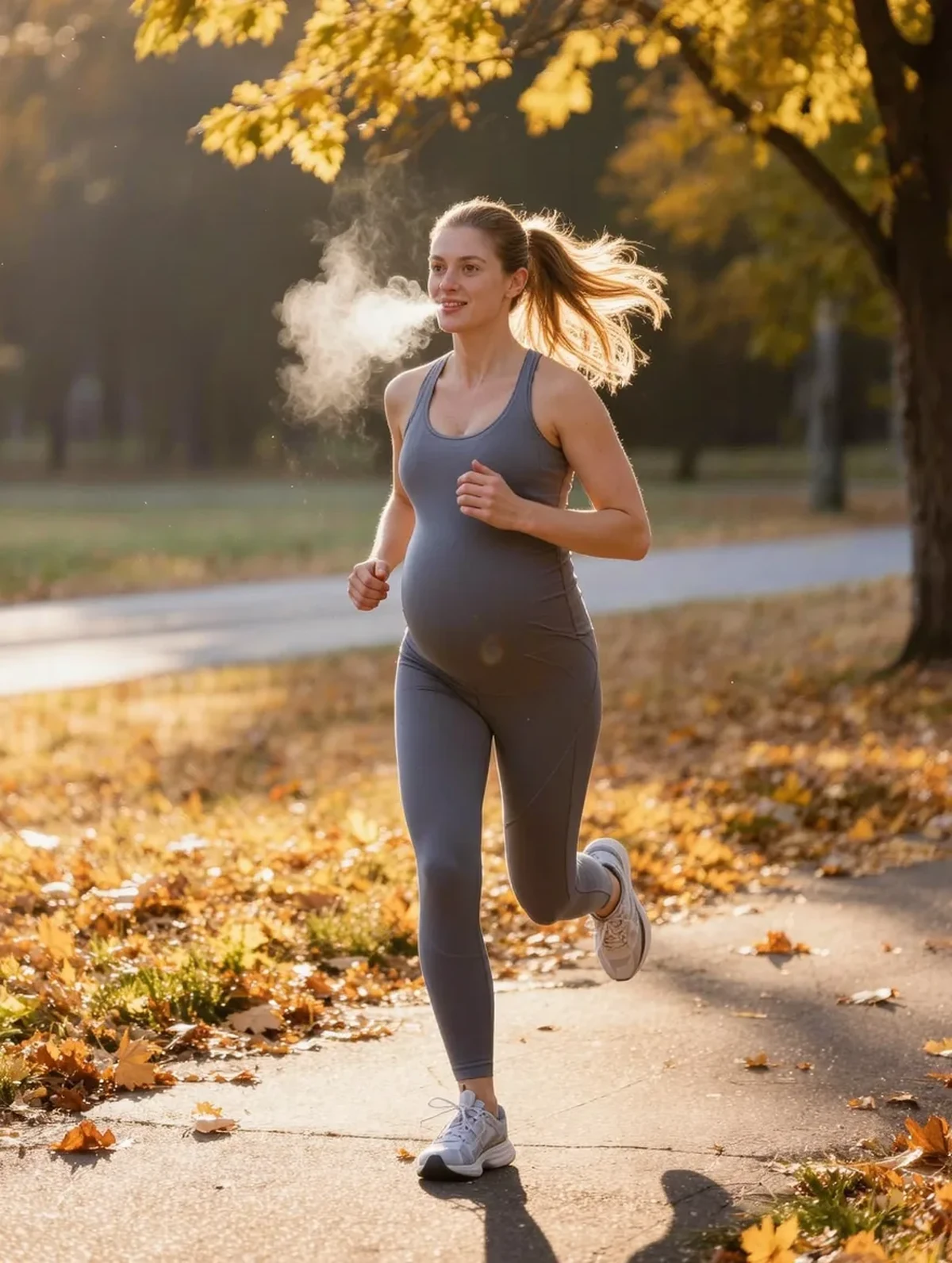
Seen here: Maternity Capris with Side Pockets — shop it on bubblelime.com
Keep Reading
This article is for general informational and styling purposes only. Fit, sizing, and product availability may vary.