Why Your Postpartum Core Routine Needs to Change Once Your Baby Starts Walking

Quick Answer: Once your baby starts walking, the demands on your core shift from stability during stillness to control during constant, unpredictable movement — chasing, sudden bending, one-arm carrying while your toddler leans and twists. A core routine built around planks and crunches trains spinal flexion and static holds, but a walking toddler mostly requires anti-rotation, anti-extension, and hip-hinge strength, since you’re now bending, lifting, and redirecting an actively moving weight dozens of times a day instead of holding a stationary one. This is also often the window where lingering diastasis recti symptoms (doming, a visible gap under load) show up for the first time, because bending-and-lifting patterns stress the midline differently than the sitting and static holding you were doing before. This is general information, not medical advice.
There’s a specific moment every parent of a new walker recognizes: your toddler takes off toward the stairs, you spin and lunge to catch them one-armed while holding a diaper bag, and something in your midsection registers effort in a way a plank never quite matched. That’s not a coincidence — it’s a completely different physical job than the one your core was doing three months ago.

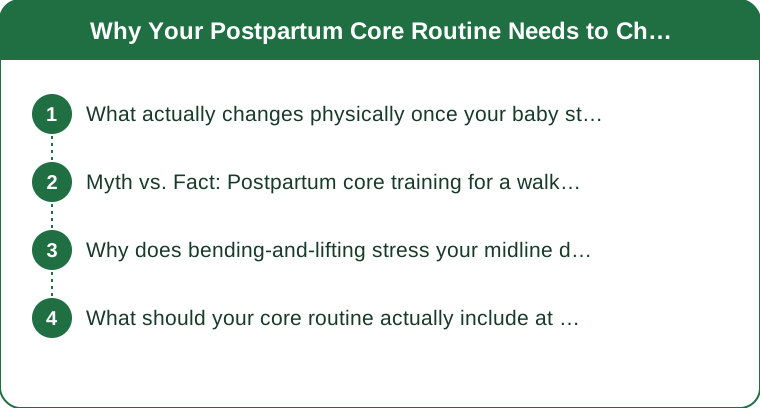
What actually changes physically once your baby starts walking?
A crawling or sitting baby is, from a biomechanics standpoint, a relatively predictable and centered load. You pick them up from roughly the same position most of the time, and your core’s job is largely to stabilize your spine while you do it. A walking toddler changes almost every variable at once: they move independently in unpredictable directions, they’re often off-balance and leaning as you catch them, and your pickups now happen from a much wider range of positions — a full squat when they’re on the floor, a lunge when they’ve toddled to the side, a twisted reach when they’re already halfway into something they shouldn’t be.
This shows up as a shift from symmetric, planned loading to asymmetric, reactive loading. Reactive loading means your core has to generate stabilizing force while already moving, not from a braced, still position — which is a meaningfully different skill than holding a plank.
There’s also a sheer volume change. Parents of new walkers report picking their child up, redirecting them, or crouching to their level dozens of times per day — often estimated at 50-100 bend-and-lift movements daily during the early walking months, compared to a much lower, more static count during the crawling stage. Even if each individual lift is light (a 20-25 pound one-year-old), the repetition volume is what makes the demand cumulative rather than occasional.
Finally, the base of support you’re working from keeps changing. You’re bending on uneven ground, on stairs, half-turned toward a door — not always the flat, planned surface a home workout mat provides. Core strength that only holds up on stable, flat ground under controlled conditions doesn’t transfer well to this kind of terrain variability.
Myth vs. Fact: Postpartum core training for a walking baby
Myth: More crunches will fix the “mom pooch” that shows up once you’re chasing a toddler. Fact: Repeated spinal flexion (the crunch motion) doesn’t address rotational or anti-extension weakness, which is what’s typically being exposed by twisting reaches and off-balance catches. If anything, heavy crunching can increase intra-abdominal pressure in a way that’s unhelpful if diastasis recti hasn’t fully closed.
Myth: If your core “worked fine” during pregnancy and early postpartum, it’ll automatically handle the walking-toddler phase. Fact: These are different tasks entirely. Pregnancy and early postpartum core demands are largely about tolerating load through the midline (weight gain, holding a stationary infant). Chasing a walker requires generating force through rotation and hip hinge under time pressure — a skill set that isn’t automatically built by the first one.
Myth: A visible ab gap or doming during a toddler pickup always means something is wrong. Fact: Some doming under a heavy or awkward lift can be a normal sign that your midline needs more anti-rotation and hip-hinge training, not necessarily a medical red flag — though a persistent bulge, pain, or doming that doesn’t resolve with technique changes is worth having checked rather than working through.
Myth: Core training for this stage means adding more ab-specific exercises. Fact: The most useful additions are often not “ab exercises” at all — they’re loaded carries, hip hinges, and rotational patterns that happen to demand core control as a side effect, which mirrors how your core is actually being used all day.
Myth: You need to wait until you’re “fully recovered” to start training for toddler-chasing demands. Fact: If you’re already doing the chasing and lifting daily regardless, training the pattern deliberately and with good form is generally more protective than avoiding it and only doing it unpracticed, in real time, under pressure.
Why does bending-and-lifting stress your midline differently than the sitting and static holds you did before?
When you sit and hold a baby, your spine is in a relatively neutral, supported position, and the load is centered close to your body. A hip hinge — the bend-at-the-hips motion required to scoop a toddler off the floor — asks something different: it requires your core to resist spinal flexion while your hips do the majority of the movement, keeping your low back from rounding under load.
This matters specifically for diastasis recti because the linea alba (the connective tissue running down the midline of your abdomen that stretches during pregnancy) is loaded differently in a hinge than in a seated hold. A poorly executed hinge — rounding through the back and bracing weakly through the front — tends to push pressure outward through a still-recovering midline, which is often when parents notice doming or gapping for the first time, even months after birth when things seemed settled.
There’s also a speed element that wasn’t present before. Picking up a stationary sitting baby is typically a slow, controlled motion. Catching a toddler mid-toddle or scooping them up before they reach the stairs happens fast, which means your core has less time to “set” before the load arrives. Training this pattern — hip hinges under moderate load, done with intentional speed variation — builds the reactive capacity that a slow, controlled home routine doesn’t automatically provide.
The practical takeaway is that hip hinge mechanics (soft knees, hips back, flat back, bracing before lifting) deserve as much deliberate practice postpartum as any specific ab exercise, because it’s the movement pattern you’re now performing dozens of times a day, often at speed and off-balance.
What should your core routine actually include at this stage?
Anti-rotation work — exercises like a Pallof press or a half-kneeling band chop — trains your core to resist unwanted twisting, which is precisely what happens when a toddler leans hard to one side mid-carry. Two to three sets of 10-12 controlled reps per side, two or three times a week, is a reasonable starting volume.
Loaded carries, particularly single-arm or offset carries (holding weight on only one side, or unevenly), mimic the asymmetric load of carrying a toddler on one hip while doing something else with your other arm. These build the exact kind of unilateral core stability that symmetric exercises like a standard plank don’t address.
Hip hinge patterns — glute bridges progressing to Romanian deadlifts with light dumbbells or a kettlebell — rebuild the lifting mechanics you’re using dozens of times daily, training your body to bend safely under both light and moderate load.
Anti-extension work, like a dead bug or a stability-ball rollout, trains your core to resist your lower back over-arching, which tends to happen when you’re reaching forward and down (picking a toy off the floor while half-turned toward your toddler, for instance).
A reasonable structure is two short sessions a week, 20-25 minutes each, rotating through one exercise from each of these four categories rather than defaulting back to a flexion-based ab circuit. This trains the pattern your body is actually repeating all day, rather than a pattern — spinal flexion — that shows up far less often in real toddler-chasing life.
TL;DR:
- Walking toddlers demand reactive, asymmetric core control instead of the static stability crawling babies required
- Parents of new walkers may perform 50-100+ bend-and-lift movements a day, often off-balance and at speed
- Doming or gapping that appears months postpartum is often a sign to add anti-rotation and hip-hinge training, not necessarily a new problem
- Swap flexion-based ab work for anti-rotation, loaded carries, hip hinges, and anti-extension exercises
Your core’s job description changed the day your baby started walking — train the job you actually have now, not the one you had when they were sitting still.
See It in Motion
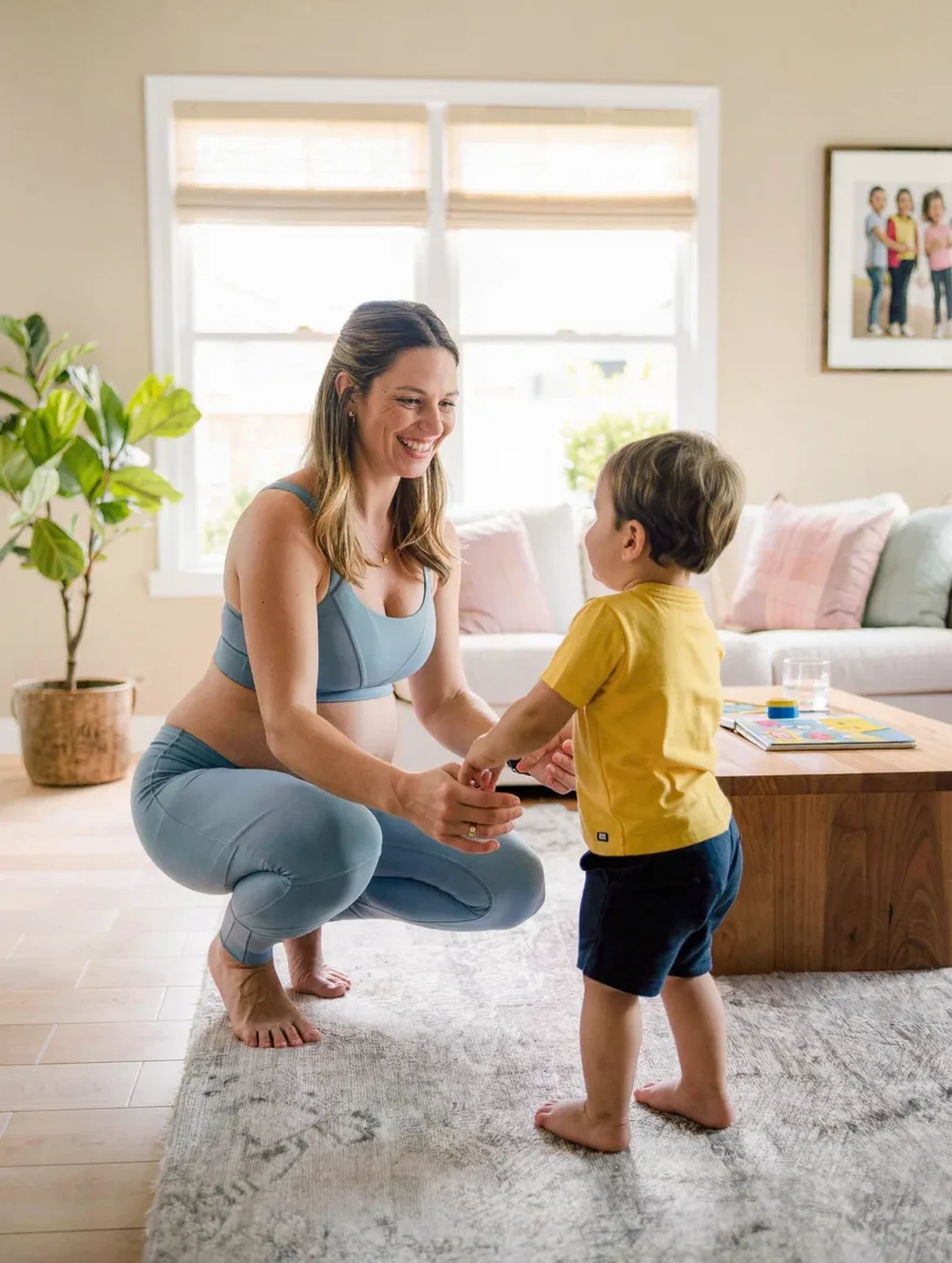
Seen here: Maternity Capris with Side Pockets — shop it on bubblelime.com
Keep Reading
This article is for general informational and styling purposes only. Fit, sizing, and product availability may vary.