Why Your Pelvic Floor Feels Heavier by Evening Postpartum (and What to Do About It)

Quick Answer: Your pelvic floor feels heavier by evening postpartum because those muscles have been holding up your pelvic organs against gravity for 10 to 14 hours, often while you lift, carry, cough and hold your breath. Muscles that are still recovering from pregnancy and birth tire by late afternoon, and the heavy, dragging feeling is that fatigue. Lie down for 10 minutes twice a day, exhale on every lift, fix constipation, and do your pelvic floor work in the morning when the muscles are fresh. If you feel a bulge, can’t fully empty your bladder, or the heaviness is getting worse week on week, book an appointment with a pelvic health physical therapist or your doctor.
You wake up and nothing feels wrong. You get through the morning feed, the school run, the laundry, the 40 minutes of standing and swaying because the baby will only nap on you.
Somewhere around 4pm it starts. A low, dragging heaviness, like something is sitting lower than it should. By bedtime you’re convinced something has shifted. Then you sleep, and in the morning it’s gone again.
That daily pattern is one of the most common things new mothers describe, and it has a clear explanation.

Why does pelvic floor heaviness get worse as the day goes on?
Your pelvic floor is a sling of muscle and connective tissue that runs from your pubic bone to your tailbone. All day long it does a job you never think about: it holds your bladder, uterus and bowel up against gravity, and it tightens every time pressure inside your belly rises.
That pressure rises more often than you’d guess. Every cough, sneeze and laugh. Every time you lift the car seat, which weighs 15 to 25 pounds with a baby in it. Every time you stand up from the sofa holding a 12-pound newborn. Every time you hold your breath and brace to get the stroller over a curb. A normal day with a baby involves hundreds of these small pressure spikes.
Before pregnancy, your pelvic floor handled them without a second thought. After a baby, the same muscles are recovering. Pregnancy stretched them for months under the growing weight of the uterus. A vaginal birth stretched them further, sometimes by two to three times their resting length during the pushing stage. Even after a C-section, nine months of load and the hormone changes of pregnancy leave the tissue softer and the muscles weaker than they were.
So you start the day with a muscle group that’s working at a fraction of its old capacity, and you ask it to hold up against gravity and absorb pressure for 14 hours straight. Like any muscle, it fatigues. A tired pelvic floor sits a little lower, holds a little less firmly, and that’s the heaviness, dragging or fullness you notice by evening.
The reason mornings feel better is simple. You just spent 6 to 8 hours lying down, even if it was broken sleep. Gravity wasn’t pulling on the organs, the muscles rested, and any mild swelling in the tissue drained. You wake up with a pelvic floor that’s at its freshest, and the cycle starts again.
This is also why the heaviness is often worse on the days you did more. The long walk with the stroller, the afternoon at the park carrying a toddler on your hip, the day you reorganized the nursery. More load, earlier fatigue, heavier evening.
Is end-of-day heaviness a sign of prolapse?
Sometimes, and it’s worth understanding what that word means before it frightens you.
Pelvic organ prolapse is when the bladder, uterus or bowel sits lower in the vagina than it should because the muscles and ligaments supporting it have stretched. It’s very common after childbirth. Studies that examine women after birth find some degree of descent in a large proportion of them, and most of those women have mild changes that improve over the first year and never need treatment.
A heavy or dragging feeling that’s worse by evening is the classic symptom of a mild prolapse. It’s also the classic symptom of a tired, deconditioned pelvic floor without any prolapse at all. From the outside, and from how it feels, the two overlap almost completely in the early months. That’s why the pattern across the day matters less than the direction over the weeks.
Here’s a useful way to think about it. If the heaviness is mild, only shows up after a long day, and is slowly getting better as the weeks pass, you’re most likely looking at recovery that’s still in progress. If it’s present most days, shows up earlier and earlier, or is getting worse rather than better, you need an assessment.
Some signs mean you should book that assessment now rather than waiting:
- You can see or feel a bulge at the vaginal opening, or something that feels like a small ball when you wipe.
- You can’t fully empty your bladder or bowel, or you need to change position to do it.
- Leaking that’s getting worse, not better.
- Pain in the pelvis or lower back that tracks with the heaviness.
- Any bleeding after your postpartum bleeding has stopped.
A pelvic health physical therapist can tell the difference with a 30-minute internal assessment, and that assessment is the single most useful thing you can do if the heaviness worries you. Prolapse that’s caught early responds well to pelvic floor training, load management and, where needed, a pessary, which is a small supportive device your doctor fits. None of that is scary, and all of it works better the earlier you start. This is general information, not medical advice.
How should you pace a day with a baby so the heaviness doesn’t build?
You can’t stop carrying your baby, and you shouldn’t try. What you can change is how the load is spread across the day, and a few small habits make a surprising difference within a week or two.
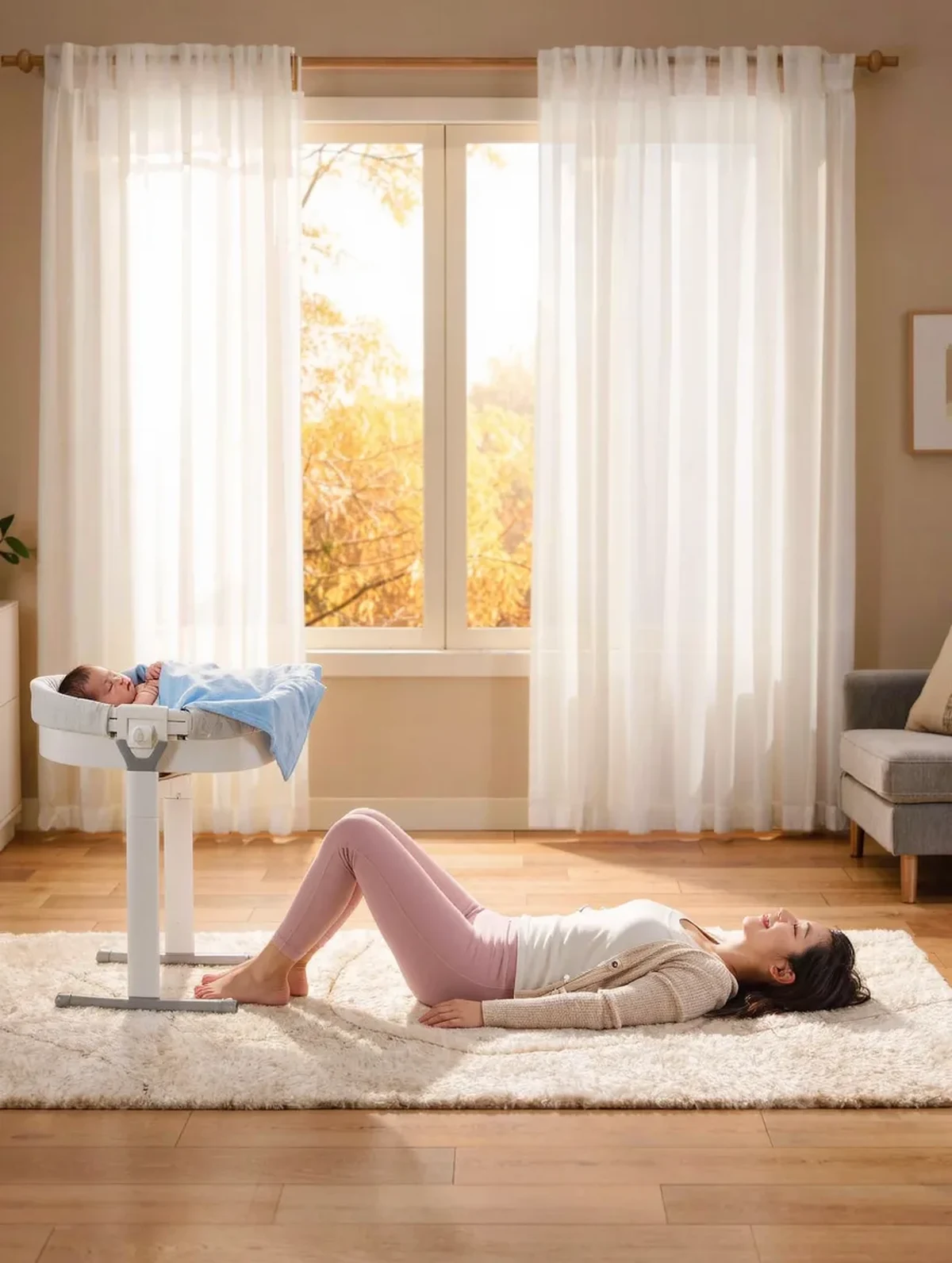
Lie down twice a day, on purpose. Ten minutes flat on your back with your knees bent, or on your side, takes gravity off the pelvic floor and lets it recover mid-day the way it does overnight. The best times are after lunch and around 4pm, before the evening rush when the heaviness usually peaks. Feed the baby lying down if you can. Put a pillow under your hips for 5 of those minutes so the pelvis sits slightly higher than the chest. New mothers who add these two rests often say the evening heaviness drops by half.
Split the standing. Forty minutes of standing and swaying to settle a baby is a long time for a recovering pelvic floor. Sit on a stability ball or the edge of a firm chair and bounce gently instead. Use the carrier for walks, not for standing in the kitchen. If the baby will only settle on you upright, set a 15-minute timer and sit down when it goes off.
Front-load the heavy jobs. Grocery trips, carrying the laundry basket, moving the car seat, a long walk with the stroller: do them before noon when the muscles are fresh. Leave the lighter tasks for the afternoon.
Stop carrying things you don’t need to. Keep a second changing station downstairs so you’re not carrying the baby and supplies up and down 10 times a day. Leave the car seat in the car and carry the baby. Use the stroller basket instead of a shoulder bag.
Hydrate and eat regularly. This sounds unrelated, but a pelvic floor that’s dehydrated and running on no lunch fatigues faster, and skipped meals feed into constipation, which we’ll come to next.
None of these require you to do less with your baby. They just move the hard parts of the day to when you can handle them.
What Nobody Tells You About Breath-Holding and Your Pelvic Floor
Ask most new mothers what’s hard on the pelvic floor and they’ll say lifting. Lifting matters, but how you breathe while you lift matters more, and almost nobody mentions it.
When you hold your breath and brace to pick something up, the pressure in your abdomen spikes. That’s the point of bracing, it stiffens the trunk. But the pressure has to go somewhere, and if your belly is braced and your ribs are locked, it goes down onto the pelvic floor. A recovering pelvic floor absorbing that spike 100 times a day is a pelvic floor that’s exhausted by dinner.
The fix is a single cue that pelvic health physical therapists teach on day one: exhale as you lift. Start the breath out just before the effort, and keep breathing out through the hardest part. Some therapists call it blow before you go. Breathing out lets the ribs come down, the deep abdominal muscles draw in gently, and the pelvic floor lifts with them instead of being pushed down. It feels strange for a day. By the end of the week it’s automatic.
Practice it on the lifts you do most:
- Picking the baby up from the crib: exhale as you lift, and bring the baby to your chest before you stand fully upright.
- Standing up from the sofa with the baby: scoot to the edge, feet under you, exhale as you rise.
- Car seat: face it, exhale, lift with the handle close to your body, never with a twist.
- Stroller over a curb: exhale and press down on the handle rather than hauling up.
The second thing nobody tells you is that sucking your belly in all day is not the same as a strong core, and it makes evening heaviness worse. Constantly pulling the stomach in raises abdominal pressure in the same downward direction as a brace. Let your belly be soft between lifts. Save the engagement for the moments that need it.
The third: coughing and sneezing count. If you’ve got a cold, which with a baby in daycare you often will, turn your head and cough with a slight forward lean and a quick pelvic floor lift. The lift is sometimes called the knack, and it takes about a week of practice before it happens without you thinking.
Why does constipation make the heaviness so much worse?
This is the one most new mothers don’t connect, and fixing it often does more for evening heaviness than any exercise.
A full, slow bowel sits directly behind and against the back wall of the vagina. When it’s loaded, it adds weight the pelvic floor has to support, and it presses forward on the other pelvic organs. Then there’s the straining. Pushing hard on the toilet is the single biggest pressure spike your pelvic floor will see all day, bigger than any lift, and it’s aimed straight down. Doing that every day in the first months after birth is one of the clearest ways to turn a tired pelvic floor into a prolapse.
Postpartum constipation is common for reasons that stack up: iron supplements, pain medication after birth, less fluid because you forget to drink while feeding, less fiber because you’re eating whatever’s within reach, fear of the first few bowel movements after stitches, and a lot less walking than you used to do.
The fixes are not glamorous, but they work fast:
- Fluids: aim for a large glass of water every time you feed the baby. That alone gets most mothers to 2 to 3 liters a day.
- Fiber: 25 to 30 grams a day. Two kiwis in the morning, oats, beans, a handful of prunes. Add it over a week, not overnight, or you’ll get bloated.
- A footstool: put your feet on a small step so your knees sit higher than your hips. It straightens the angle of the rectum and makes emptying easier without straining.
- No straining: lean forward, elbows on knees, belly soft, and breathe out with a low sound, like a long ahh. If nothing happens in 5 minutes, get up and try later.
- Timing: the bowel is most active in the 20 to 30 minutes after breakfast and after a warm drink. Don’t ignore that window.
- Walk: 15 minutes outside with the stroller gets things moving in a way nothing else does.
If you’re on iron and it’s causing trouble, ask your doctor about a different formulation or alternate-day dosing. If you’re still straining after two weeks of the above, a gentle stool softener is reasonable, and your doctor or pharmacist can advise. Once your bowel is easy, a lot of mothers find the evening heaviness simply fades.
What exercises help, and when in the day should you do them?
The right work makes the pelvic floor stronger and more enduring. Done at the wrong time or in the wrong way, it adds to the fatigue. Both the content and the timing matter.
Do your pelvic floor training in the morning. A muscle learns and strengthens best when it isn’t already exhausted. Pelvic floor contractions at 9am, while you’re lying down feeding the baby, will be stronger and cleaner than the same contractions at 8pm when the muscles are tired and the heaviness is at its peak. If you’ve been doing kegels at night and feeling like they make things worse, this is why.
A simple starting program, lying on your back with knees bent:
- Long holds: squeeze and lift, as if stopping gas and urine at the same time, hold for 5 seconds, relax fully for 5 seconds. 10 reps. Build the hold to 10 seconds over 4 weeks.
- Quick flicks: 10 fast, sharp squeezes with a full relax between each. These train the reflex you need for coughs and sneezes.
- The relax matters as much as the squeeze. A pelvic floor that never fully lets go gets tight and tired and feels heavy too.
Do that once in the morning and once at lunch, 3 to 5 days a week. Twice a day is plenty. More is not better.
Add the rest of the body, because a pelvic floor doesn’t work alone. Three times a week, 15 minutes:
- Glute bridges: 3 sets of 10, exhale as you lift, with a gentle pelvic floor lift at the top.
- Side-lying clamshells: 2 sets of 15 each side.
- Wall sits or sit-to-stands: 2 sets of 10, exhale on the way up.
- Dead bugs: 2 sets of 8 each side, slow, breathing out as the leg extends.
Hold off on impact, running, jumping, heavy lifting and long planks until the evening heaviness has settled and you’ve been checked. A good rule: if an exercise makes the heaviness show up during or within an hour afterward, it’s too much for now. Scale it down and come back to it in two weeks. Most women who follow a program like this feel a clear change in 6 to 8 weeks.
FAQ: Postpartum Pelvic Heaviness Questions, Answered
How long does evening pelvic heaviness last after birth?
For most women it improves steadily over the first 3 to 6 months as the tissue recovers and the muscles rebuild. Many notice a big change by 12 weeks, especially once they fix constipation and start exhaling on lifts. If it’s not improving at all by 3 months, or it’s getting worse, book an assessment with a pelvic health physical therapist. Breastfeeding can slow the timeline a little because of lower estrogen, which keeps the tissue softer, and that often improves after weaning.
Can I still exercise if my pelvic floor feels heavy at night?
Yes, with the timing and type adjusted. Exercise in the morning when the muscles are fresh, stick to low-impact strength and walking, exhale on every effort, and treat heaviness during or after a session as a sign to scale back. Lying-down work like bridges, clamshells and dead bugs is fine even on heavy days. Save running and jumping until the heaviness has settled and you’ve been checked.
Does a postpartum support belt or shorts help with heaviness?
Supportive compression shorts or a pelvic support garment can reduce the heavy feeling during a long day on your feet, and many women find them useful for the first few months, especially for walks and outings. They’re a tool for comfort, not a cure. They don’t strengthen anything, so pair them with the training and pacing above rather than relying on them. Ask a pelvic health physical therapist which type suits your symptoms, because the right garment depends on what’s going on underneath.
TL;DR:
- Evening pelvic heaviness postpartum is usually a recovering pelvic floor fatiguing after 10 to 14 hours of holding against gravity and absorbing hundreds of pressure spikes.
- Lie down for 10 minutes twice a day, front-load heavy jobs before noon, and split long stretches of standing with the baby.
- Exhale on every lift, cough and sneeze, and stop sucking your belly in between efforts.
- Fix constipation with fluids, fiber, a footstool and zero straining, then do pelvic floor training in the morning, not at night.
- Heaviness that’s getting worse, a bulge, or trouble emptying means a pelvic health physical therapy assessment now, not later.
Start with the two lie-downs and the exhale cue this week. Those two changes alone take the edge off the evening heaviness for most mothers within days, and they cost nothing. This is general information, not medical advice. If you have any of the warning signs above, see your doctor or a pelvic health physical therapist.
See It in Motion
Seen here: Maternity Capris with Side Pockets — shop it on bubblelime.com
Keep Reading
This article is for general informational and styling purposes only. Fit, sizing, and product availability may vary.