Why Lifting Your Toddler Strains Your Core After Birth

Quick Answer: Feeling a pull or pressure when you lift your toddler is common after birth. Your deep core and pelvic floor are still rebuilding their timing, so the load shows up in the wrong place. Lift with your legs, keep the child close, and practice a few breath-and-brace drills each day. Pain, heaviness, or leaking is a sign to check in with a clinician.
You bend down to scoop up your toddler, and something in your belly tightens. Maybe it feels like a pull under the ribs, or a heavy pressure low in your pelvis. You grab the couch to steady yourself, and you wonder why picking up your own kid feels so hard. You are not weak, and you are not imagining it. Lifting is one of the most demanding everyday tasks after birth.

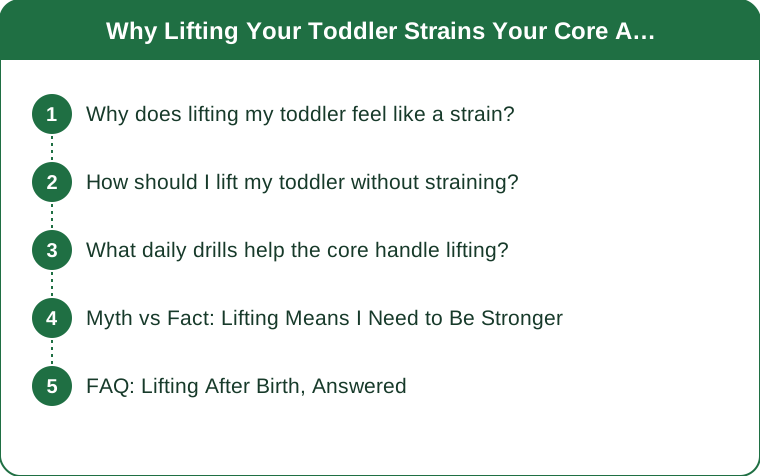
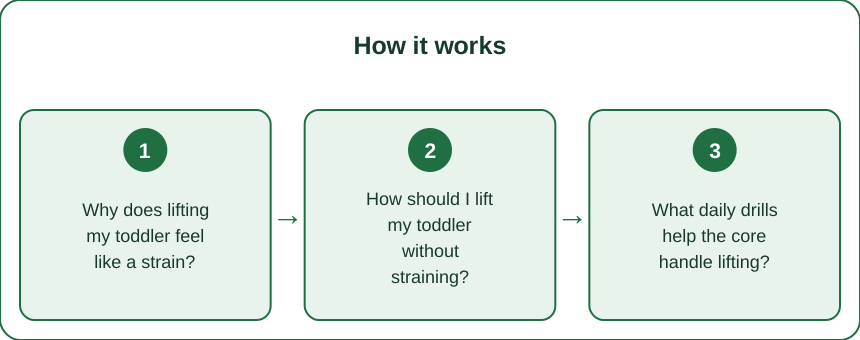
Why does lifting my toddler feel like a strain?
Your center of gravity moved during pregnancy, and your deep core spent months adapting to a bigger load. Once the baby arrives, the inner wall of your abdomen and the pelvic floor have to work with your breath and your hips again. A squat-and-lift takes all of that at once.
A toddler is also heavier and less predictable than a newborn. When they wiggle or reach, your body braces in a hurry, and the pressure can shoot up into the belly instead of spreading through the hips and legs.
How should I lift my toddler without straining?
Start with the setup. Bring your child close to your body before you lift, so the weight sits over your center instead of out in front. Keep your feet about hip-width apart, bend at the hips and knees together, and push through your legs as you stand.
Breathe out as you rise, and let your ribs drop gently down on the way up. Avoid twisting while holding the child. Turn your whole body with your feet instead.

What daily drills help the core handle lifting?
Try three drills each day. First, belly breathing with a gentle exhale: 5 slow breaths, letting your ribs widen and settle. Second, a supported bridge: 2 sets of 8 with a slow lower. Third, a sit-to-stand from a chair with a gentle brace: 3 sets of 6.
Keep the reps light and controlled. The aim is smooth timing between breath, brace, and lift, not a hard workout. Add one set at a time as your body feels steady.
Myth vs Fact: Lifting Means I Need to Be Stronger
Myth: You just need to get stronger before you can lift your toddler without pain.
Fact: Timing and technique matter as much as strength. A stronger core that fires too late still gets overloaded. Practicing a good setup, a steady breath, and close holding often makes the biggest difference within a few weeks.
FAQ: Lifting After Birth, Answered
Is it normal to feel pressure when I lift my toddler?
Mild pressure during the first months can be part of recovery. Sharp pain, bulging, or leaking is not, so check in with a clinician if any of those show up.
Should I stop carrying my toddler altogether?
No. Keep carrying but lighten the load when you can. Let your child walk short distances, sit on a hip instead of holding them high, and use a step stool for reaches.
When should I see a pelvic floor physical therapist?
If you have ongoing heaviness, leaking, pain during lifting, or a feeling that something is bulging, book an evaluation. This is general information, not medical advice.
TL;DR:
- A strain when lifting your toddler after birth is common and usually improves with practice.
- Bring the child close, bend at the hips and knees, and breathe out on the way up.
- Three short daily drills build timing between breath, brace, and lift.
- Pain, bulging, or leaking means it is time to see a pelvic floor physical therapist.
See It in Motion
Seen here: Maternity Capris with Side Pockets — shop it on bubblelime.com
Keep Reading
This article is for general informational and styling purposes only. Fit, sizing, and product availability may vary.