Why Cold Weather Changes Postpartum Training More Than You Expect

Quick Answer: Cold weather changes postpartum training through four separate mechanisms, not one. Connective tissue gets stiffer and needs a longer warm up, the pelvic floor responds to cold and to coughing differently than it did in summer, appetite and energy shift, and the practical windows for training shrink because everything with a baby takes longer in cold weather. Plan for a warm up twice as long, keep the work indoors and short, and expect the calendar to be the real limiting factor rather than your body.
The first genuinely cold week catches almost everyone off guard. You had something working — a short routine, a walk, a rhythm with naps — and then the temperature drops ten degrees and the whole thing quietly stops working. It is easy to read that as losing momentum. It is usually four specific things happening at once, and each one has a fix.
This is general information, not medical advice.

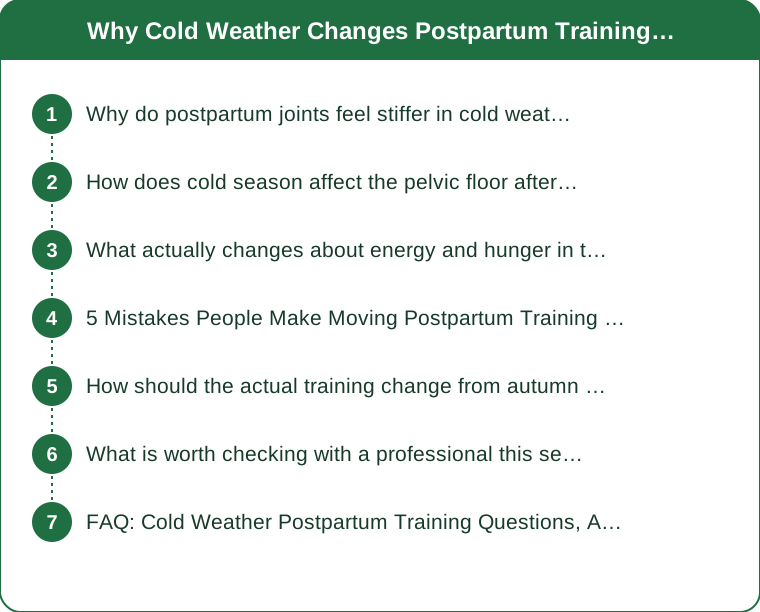
Why do postpartum joints feel stiffer in cold weather than they did in summer?
Two things are happening, and they stack.
The first is universal. Connective tissue — tendon, ligament, fascia — is viscoelastic, which means its stiffness depends on temperature. Cooler tissue is stiffer tissue, and stiffer tissue reaches its comfortable range of motion later in a session. This is why the squat that felt fine in August feels short and grippy in October at the same depth. Nothing has gone backwards. The tissue is simply starting colder and warming more slowly.
The second is postpartum specific. Relaxin and the hormonal changes of pregnancy alter ligament behaviour, and while relaxin levels fall within days of birth, the tissue changes take considerably longer to normalise — commonly several months, and longer if you are breastfeeding. So you are entering the cold season with connective tissue that is already behaving differently from your pre-pregnancy baseline, and then adding a temperature effect on top.
What this looks like in practice. Hips and the front of the ankle feel tight for the first ten minutes. The wrists and thumb base, if you have had any mum-thumb symptoms, feel worse in the cold. And the sacroiliac area, which is the classic postpartum grumbler, is more likely to give you a sharp catch on the first few reps than it was in warm weather.
The fix is not stretching harder. It is warming longer. In summer a five minute warm up was probably enough. From now until spring, give it ten to twelve minutes, and make it movement rather than holds: marching, slow bodyweight squats to a chair, arm circles, hip circles, calf raises. You are raising tissue temperature, and holding a stretch does not do that. Sixty to ninety seconds of anything that raises your pulse will do more for range of motion than three minutes of sitting in a hamstring stretch.
If you only change one thing this season, change this one. Most of the cold weather aches people attribute to doing too much are actually the cost of starting cold.
How does cold season affect the pelvic floor after birth?
This is the part nobody warns you about, and it catches people who thought they were past the pelvic floor stage.
Coughing is the main mechanism. Autumn and winter mean respiratory viruses, and with a baby or a nursery-age child in the house, you will catch more of them than you used to. A cough is a sudden, high-pressure event: intra-abdominal pressure spikes and the pelvic floor has to counter it reflexively. A floor that is coping perfectly well with normal life can leak during a two-week cough, and that can be the first leaking you have had in months. It is not a sign that your recovery has reversed. It is a load that exceeds what the system currently handles.
The practical response is to brace deliberately: when you feel a cough coming, cross your legs or lean forward slightly, and exhale through the cough rather than holding your breath into it. This feels fussy and it genuinely works. If a cough is going to run for two weeks, it is worth doing.
Cold itself plays a smaller role. Cold triggers a general increase in muscle tone, including in the pelvic floor, and some people find that an already tense floor — the overactive pattern, not the weak one — feels worse in winter, with more urgency and more discomfort rather than more leaking. If your symptom picture is urgency and tightness rather than leaking, the answer is downtraining and breathing work, not more kegels. Doing strengthening work on an overactive floor makes it worse, which is why the generic advice to do more pelvic floor exercises is not always right.
And then there is the bladder. Cold weather increases urine production and reduces the interval between urges. Combined with the fact that getting a baby dressed to leave the house takes fifteen minutes, this is the season where a lot of people start delaying, which trains the bladder badly. Go when you need to.
If leaking is persistent past a cough, or urgency is dictating your day, this is exactly what a pelvic health physiotherapist is for. It is a short course of treatment for most people and it is far more effective than another six months of guessing.
What actually changes about energy and hunger in the first cold months postpartum?
Appetite goes up in cold weather for almost everyone, and postpartum that effect lands on top of an appetite that is already unusual.
If you are breastfeeding, your energy requirement is elevated — commonly cited around 400 to 500 extra calories a day, though the real figure varies with how much milk you are producing. Cold weather adds a modest amount of its own through thermoregulation, mostly if you are outdoors a lot. The two together can produce a genuinely large appetite, and it is easy to interpret that as a problem when it is simply demand.
The thing to protect is protein and iron, not calories. Postpartum iron stores are often low, especially after significant blood loss at birth, and low iron feels almost exactly like the fatigue everyone attributes to broken sleep: heavy legs, breathlessness on stairs, a workout that feels twice as hard as it should. This is worth an actual blood test rather than an assumption. Cold weather does not cause it, but the winter version of low iron is more miserable, and it is the single most common fixable reason a postpartum training plan stalls in autumn.
Daylight matters too. Less morning light shifts sleep timing later and makes the early wake-ups harder, and mood dips are common in the first cold months even in people who have never had a seasonal pattern. If you can get outside within an hour or two of waking, even under cloud, do it — the light intensity outdoors on an overcast day is still an order of magnitude greater than indoor lighting. A ten minute walk with the pram counts.
Practical version. Eat before you train rather than after, because the fasted morning session that worked in July tends to fall apart in November. Keep protein at each meal rather than loading it into dinner. And stop treating a bigger appetite as a discipline failure. It is a supply and demand calculation, and demand is genuinely up.

5 Mistakes People Make Moving Postpartum Training Indoors
1. Keeping the same warm up. Covered above, and the most common of all. The session did not get harder. It got colder. Ten to twelve minutes of movement before anything loaded.
2. Swapping walking for nothing. Most postpartum plans are quietly built on a daily walk, and when the weather turns, the walk disappears and nothing takes its place. The walk was doing a lot: circulation, mood, low-level conditioning, and a reset for a difficult afternoon. Replace it deliberately — a shorter walk in better clothing, a stair session in the building, or fifteen minutes of pacing on a call — rather than letting it evaporate.
3. Training in a cold room and blaming your body. A living room at sixteen degrees is a different environment from a gym at twenty-two. If the room is cold, the first fifteen minutes will feel bad no matter how well you are recovering. Warm the room or add a layer you take off after the warm up.
4. Going up in load because the sessions got shorter. The natural response to a fifteen minute window is to make it more intense. Postpartum, and especially with broken sleep, intensity is the variable that costs the most in recovery. Shorter and the same load is fine. Shorter and heavier is where the sacroiliac pain comes from.
5. Abandoning the plan because the week fell apart. Illness season means genuinely disrupted weeks, repeatedly, and a plan that assumes four consistent sessions will feel like failure by mid-October. Build the plan around two sessions you will actually do, and treat anything else as a bonus. A two-session plan completed beats a four-session plan abandoned, and in this particular season it is not close.
How should the actual training change from autumn to winter?
Less than people expect in content, more than people expect in structure.
Keep the same movements. If you were working through a progression of hip hinges, squats, carries, and pressing, keep all of it. There is nothing about cold weather that requires different exercises, and switching programme every season is one of the main reasons postpartum strength takes so long to come back.
Change the session shape. A realistic cold-season session for most people is: twelve minutes of warm up, twenty minutes of work, and no cool down beyond putting a jumper on. That is enough to progress on. Two of those a week, held for three months, produces more than an ambitious plan held for three weeks.
Prioritise carries and single-leg work. Both translate directly into the winter version of parenting: carrying a heavier, more layered baby up stairs, across icy pavement, in and out of a car seat. Suitcase carries and split squats give you more real-world return per minute than almost anything else, and they load the trunk in a way that is generally kinder to the postpartum core than crunching patterns.
Use the warm up as the barometer. If the warm up still feels stiff at minute ten, extend it rather than pushing into the work. If it feels good at minute six, you have a green light. This is a much more reliable read on readiness than how much sleep you got, and it stops you making the training decision at 6am in the dark on emotion.
And keep one outdoor thing. Even once a week. The light and the change of environment do something for mood that indoor training does not, and mood is the thing that actually determines whether the plan survives to February.
What is worth checking with a professional this season?
Three things move from ‘monitor it’ to ‘get it looked at’ in the cold months.
Leaking that outlasts the cough. A cough-driven leak that resolves when the cough resolves is a load story. A leak that is still there two weeks after the cough has gone is a pelvic floor story, and a pelvic health physiotherapist will sort it far faster than time will.
Fatigue that does not track with sleep. If you had a good night and still could not get through the warm up, that is the pattern that suggests iron, thyroid, or something else measurable rather than simple exhaustion. Postpartum thyroiditis typically shows up in the first year and is easy to miss because every symptom is also a symptom of having a baby. A blood test is a low-cost way to stop guessing.
Joint pain that is sharp rather than stiff. Stiff and warming up within ten minutes is the normal cold-weather picture. Sharp, localised, and worse over weeks is not, particularly around the pubic symphysis or sacroiliac joints, where postpartum presentations are common and genuinely treatable.
None of these are emergencies and none of them mean stopping. They mean the answer is diagnostic rather than motivational, which is good news, because motivation is the harder problem to fix.
If you are still in the first twelve weeks after birth, or you had a caesarean, a third or fourth degree tear, or any complication, the sequencing of all of this should come from your own clinician rather than from a general article.
FAQ: Cold Weather Postpartum Training Questions, Answered
Is it safe to take a newborn out for walks in cold weather?
Generally yes, with sensible layering and attention to the baby’s hands, feet and face, but the guidance varies by age and by how cold ‘cold’ is where you live. Ask your health visitor or paediatric clinician for a temperature threshold rather than guessing. For your own training, a cold walk with a well-dressed baby is usually the easiest session of the week to keep.
Should I do my pelvic floor exercises more often now that I am coughing?
More useful than more frequent exercises is the brace itself — crossing your legs or leaning forward and exhaling through each cough. If you are already doing a daily pelvic floor routine, keep it as is. Adding volume during an illness tends to fatigue the floor rather than strengthen it.
My joints ache first thing every cold morning. Is that damage?
Almost certainly not. Morning stiffness that eases within twenty to thirty minutes of moving is the classic cold-weather and postpartum picture, and it improves as tissue temperature rises. Stiffness that lasts more than an hour every morning, especially with swelling, is a different pattern and worth mentioning to a doctor.
TL;DR:
- Cold makes connective tissue stiffer, so double your warm up to ten to twelve minutes of movement before anything loaded — this fixes most of the aches people blame on overdoing it.
- Cough season is the real pelvic floor challenge. Brace and exhale through coughs, and see a pelvic health physio if leaking outlasts the cough.
- Appetite rising is demand, not failure. Protect protein, get iron checked if fatigue does not track with sleep, and get outdoor light early.
- Keep the same movements, shrink the session, and build the plan around two sessions a week that survive a disrupted month.
The first cold month postpartum is not a setback, even though it reliably feels like one. It is four small mechanical changes arriving at the same time, and every one of them has a fix that takes minutes rather than months. Lengthen the warm up, keep one outdoor thing, and let the plan get smaller so it survives the winter rather than dying in November.
See It in Motion
Seen here: Maternity Capris with Side Pockets — shop it on bubblelime.com
Keep Reading
This article is for general informational and styling purposes only. Fit, sizing, and product availability may vary.