Why a Sleep Regression Sets Back Your Postpartum Training Recovery Harder Than It Used To

Quick Answer: A sleep regression hits your training recovery harder now because you’re stacking a new deficit on top of a baseline that’s already reduced — postpartum sleep is frequently fragmented even on “good” nights, so a regression doesn’t drop you from a full tank to empty, it drops you from already-low to critically low. Regressions (common around 4, 8, and 12 months, plus illness or teething stretches) also tend to fragment the specific sleep stages tied to physical recovery, particularly the first block of deep slow-wave sleep, which is when most of your nightly growth hormone release happens. Add breastfeeding energy demands and the cortisol effects of chronic under-sleep, and the same number of “bad nights” that you’d have shrugged off pre-baby can measurably slow muscle repair, raise injury risk, and blunt motivation. The fix is to train by recovery signals during a regression, not by your usual schedule. This is general information, not medical advice.
You know the feeling: a sleep regression hits, and a workout that would have been routine six months ago suddenly feels like wading through wet sand. It’s tempting to assume you’re just being soft about tiredness you used to handle fine — but the physiology says otherwise, and it’s worth understanding why before you push through it the same way you used to.

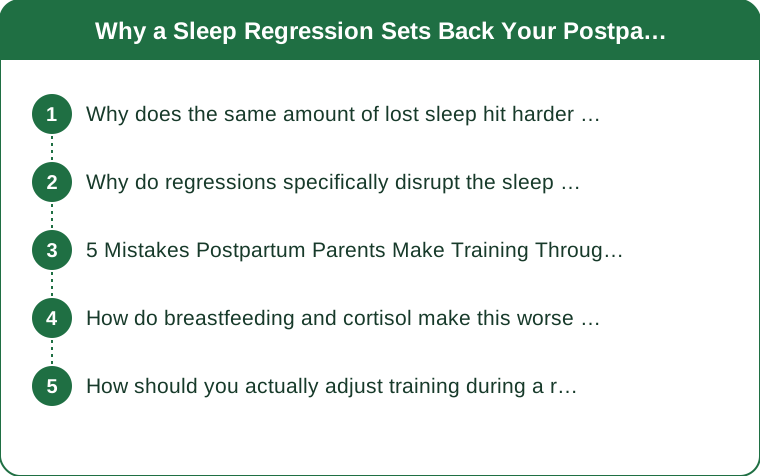
Why does the same amount of lost sleep hit harder now than it did before baby?
The key concept here is baseline sleep debt. Sleep debt accumulates when you consistently get less sleep than your body needs, and it doesn’t fully reset with a single good night — it builds gradually over weeks. Pre-baby, an occasional rough night (travel, a late deadline, a loud neighbor) was typically a withdrawal from a fairly full account. Postpartum, many parents are running a chronic partial deficit even on “normal” nights, because of night feeds, early wakings, or a baby who still surfaces briefly between sleep cycles.
When a regression hits on top of that, you’re not dropping from full to partial — you’re dropping from partial to severely depleted. This matters physiologically because recovery processes (muscle protein synthesis, glycogen replenishment, connective tissue repair) are cumulative and somewhat dose-dependent on sleep quantity and quality across multiple nights, not just the most recent one. A body already running a deficit has less buffer before recovery processes measurably slow down.
There’s also a compounding awareness gap. Pre-baby sleep loss was usually acute and visible — you knew you were tired and could plan around it. Postpartum sleep fragmentation can be less obvious day to day, especially once you’ve adapted to functioning on less, which means a regression’s added effect can sneak up on you: you feel generally tired most days anyway, so it’s harder to notice exactly when you’ve crossed from “manageable” into “under-recovered enough that training intensity should change.”
The practical upshot is that comparing a current regression to how you handled sleep loss pre-baby is comparing two different starting points, not two different tolerance levels — your capacity hasn’t gotten worse, your starting account balance has.
Why do regressions specifically disrupt the sleep stages tied to physical recovery?
Not all sleep is equal for recovery purposes. Roughly 70-80% of your nightly growth hormone release — the hormone most directly tied to tissue repair and muscle recovery — occurs during the first block of slow-wave sleep (deep sleep), typically in the first 90-120 minutes after falling asleep. This is why sleep quality in the first sleep cycle of the night matters disproportionately for physical recovery, more than total hours alone.
Sleep regressions frequently involve more frequent night wakings that specifically intrude on this early window — a baby working through a developmental leap, a new skill, or teething discomfort tends to wake and resettle repeatedly through the first part of the night, precisely when that first deep-sleep block would otherwise be uninterrupted. Even if your total sleep hours during a regression don’t drop dramatically, the fragmentation of that first deep-sleep window can reduce the growth hormone release tied to it more than the raw hours-lost number would suggest.
There’s a secondary effect on REM sleep, concentrated more in the later part of the night, which is more associated with cognitive recovery, motor learning, and mood regulation than with pure muscle repair — but which still affects your motivation, coordination, and pain perception during a workout. A regression that also delays bedtime or causes very early wakings can compress REM-heavy late-night sleep even when the deep-sleep portion is relatively protected, which is one reason regressions can leave you both physically under-recovered and mentally flat at the same time.

5 Mistakes Postpartum Parents Make Training Through a Sleep Regression
Mistake 1: Keeping training intensity identical to your well-rested baseline. Under-recovered muscle and connective tissue handle high-intensity or high-load work less safely — reaction time and coordination both measurably decline with significant sleep loss, which raises the real risk of a form breakdown or misstep during a heavy lift or fast run.
Mistake 2: Trying to “catch up” with a single hard session once a good night finally happens. One night of solid sleep doesn’t clear a week or two of accumulated deficit, and hitting it hard on the first decent night often just adds fatigue on top of a recovery process that’s still in progress.
Mistake 3: Cutting protein and hydration along with everything else that feels hard to manage. Sleep deprivation already impairs muscle protein synthesis somewhat on its own; under-fueling on top of that compounds the recovery slowdown rather than offsetting it.
Mistake 4: Ignoring mood and motivation changes as “just tiredness.” Sleep loss affects cortisol regulation and emotional regulation together, and postpartum mood changes deserve attention on their own terms — not dismissal as a normal side effect of a rough sleep patch, especially if low mood persists beyond the regression itself.
Mistake 5: Assuming a full stop is the only alternative to training as normal. All-or-nothing thinking (either the full usual workout or nothing) often means choosing nothing during a hard stretch. A scaled-down version — lighter loads, shorter duration, walking instead of running — usually protects both consistency and recovery better than either extreme.
How do breastfeeding and cortisol make this worse than a typical adult sleep regression response?
If you’re breastfeeding, your body is managing an additional 300-500 calorie-per-day energy demand on top of normal training recovery needs. Sleep loss independently tends to increase appetite-regulating hormone disruption (lower leptin, higher ghrelin), which can shift cravings toward quick-energy foods rather than the steady protein and micronutrient intake that recovery actually benefits from — a mismatch that’s easy to fall into during an exhausting stretch when cooking feels like one task too many.
Cortisol, your primary stress hormone, follows a daily rhythm that’s disrupted by fragmented sleep — chronically elevated or irregular cortisol patterns are associated with slower tissue repair and can also blunt the perceived benefit of exercise, meaning workouts may feel like they’re “not working” during a regression even when you’re still showing up for them. This is a temporary physiological pattern tied to the sleep disruption, not a sign that your training approach itself has stopped being effective.
There’s also a hydration angle specific to breastfeeding: milk production draws on your fluid reserves, and sleep-deprived days often come with less consistent water intake simply because normal routines (including remembering to drink) are harder to maintain. Mild dehydration on top of sleep loss and breastfeeding’s fluid demands can independently worsen perceived fatigue and workout performance, which is a fixable piece even when the sleep itself is out of your control.
How should you actually adjust training during a regression, without losing your progress?
Shift to RPE-based training (rate of perceived exertion) rather than fixed weights or paces for the duration of the regression. If a weight that’s normally an “RPE 7” (moderately hard) suddenly feels like an RPE 9, that’s useful information — reduce the load to match how it actually feels that day rather than the number on paper from a better-rested week.
Prioritize frequency over intensity. Several short, easy sessions (15-20 minutes of walking, mobility work, or light resistance training) tend to preserve training habit and some fitness better during a hard sleep stretch than trying to preserve your usual heavier sessions at reduced frequency.
Protect protein intake specifically, even when overall appetite or meal planning suffers. Aiming for a protein source at each meal, even a simple one (Greek yogurt, eggs, a protein shake), supports the muscle repair processes that sleep loss is already working against.
Treat the regression as temporary and self-limiting. Most regressions resolve within 2-6 weeks as the underlying developmental leap, teething, or illness passes. Scaling training down for that window is a short-term adjustment, not a permanent step back — and returning to full intensity once sleep stabilizes typically happens faster than parents expect, since the fitness itself wasn’t lost, just temporarily inaccessible.
If exhaustion, low mood, or physical symptoms feel disproportionate to the sleep loss itself, or persist well past the regression’s usual timeline, that’s worth raising with your provider rather than continuing to attribute everything to the baby’s sleep alone.
TL;DR:
- Postpartum baseline sleep debt means a regression drops you from already-low to critically low, not full to empty
- Roughly 70-80% of nightly growth hormone release happens in the first deep-sleep block, which regressions disrupt most
- Common mistakes: keeping intensity constant, “catching up” with one hard session, and all-or-nothing thinking
- Train by RPE and prioritize frequency over intensity until the regression passes (typically 2-6 weeks)
Your training didn’t get less effective during the regression — your recovery budget got smaller, and matching your effort to that budget is what protects the progress you’ve already made.
See It in Motion
Seen here: Maternity Capris with Side Pockets — shop it on bubblelime.com
Keep Reading
This article is for general informational and styling purposes only. Fit, sizing, and product availability may vary.