Postpartum Training When Your Sleep Is Still Broken: The Complete Guide

Quick Answer: Broken sleep reduces recovery capacity, not your ability to train - so the answer is lowering volume and frequency while keeping intensity honest, rather than doing more easy work. Two or three short strength sessions a week at genuinely challenging loads produce better results than five gentle ones when you are sleeping in fragments. Track how you feel two days later, not during, and treat any session that leaves you worse for 48 hours as too much.
Every postpartum program assumes a baseline of sleep that you do not have. So you follow it, feel steadily worse, conclude you are not recovering, and stop. The program was not too hard. It was written for a body that consolidates sleep at night, and yours is doing something else right now.

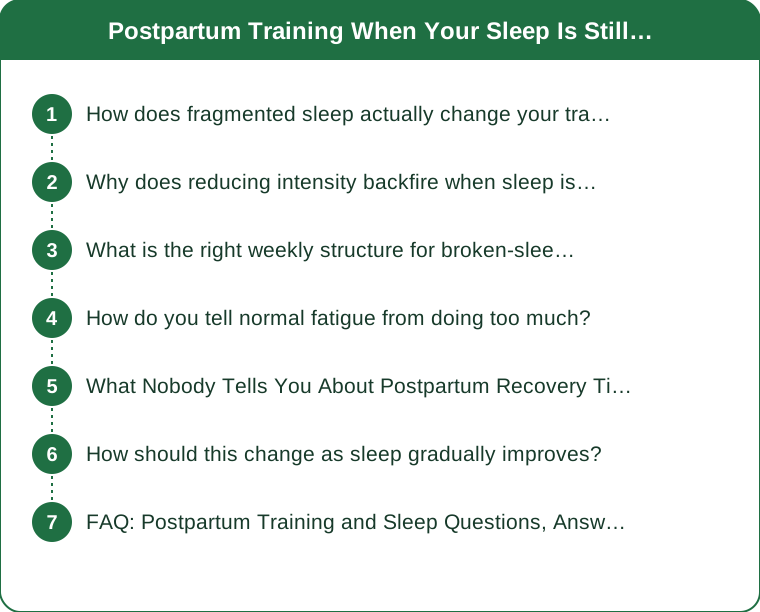
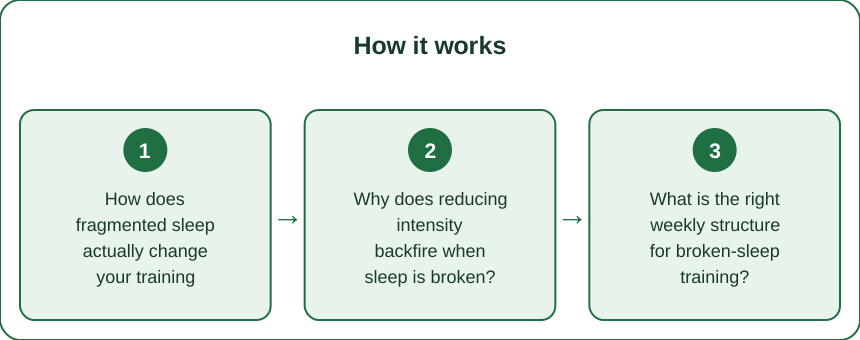
How does fragmented sleep actually change your training capacity?
The largest effect is on recovery between sessions rather than on performance within one. Most people can produce close to normal strength output in a single session on poor sleep - what changes is how long it takes to return to baseline afterward.
Growth hormone release concentrates in deep sleep, and deep sleep is what fragmented nights cut most severely. Waking every two to three hours can substantially reduce the deep sleep that muscle repair depends on, even when total hours look acceptable on paper.
There is a perception effect too. Poor sleep raises perceived exertion, so the same weight genuinely feels heavier. This is the point where most people conclude they have lost strength and reduce load, when the accurate read is that the load feels harder while producing similar output.
The practical consequence is specific: a session that needed 48 hours of recovery before may need 72 now. If your program assumes 48, you accumulate a deficit every single week, and by week four you feel like you are going backwards - because in terms of recovery debt, you are.
The fix is not to train easier. Easy sessions still cost recovery while providing much less stimulus, which is the worst trade available when your recovery budget is the scarce resource.
Why does reducing intensity backfire when sleep is broken?
Because the stimulus for keeping strength and bone density comes from load, and gentle work does not supply it. The intuitive move on four hours of broken sleep is a long, light session. It feels appropriate and it is precisely backwards.
A 45-minute light circuit and a 20-minute session of three challenging compound lifts cost roughly comparable recovery. The second delivers far more of what postpartum bodies specifically need - the strength around joints that have spent months under changing load, and the bone stimulus that matters especially while breastfeeding.
Think of recovery as a weekly budget that has shrunk. When a budget shrinks, you do not buy more cheap things. You buy fewer valuable ones.
In practice that means dropping to two or three sessions a week, keeping the sets low - two to three working sets per movement - and keeping the weight genuinely challenging, in the range where the last two repetitions require real effort.
This is also easier to actually do. Twenty minutes is findable in a fragmented day in a way that 45 minutes is not, and finishing beats a program you abandon in week three.
What is the right weekly structure for broken-sleep training?
Two to three sessions, 20 to 30 minutes, with at least 72 hours between sessions that hit the same pattern. That is the whole framework, and its simplicity is a feature when your executive function is also running short.
A workable split is two full-body sessions - one squat-pattern focused, one hinge-and-push focused - placed on the two days most likely to have some support available. Do not schedule them on consecutive days.
Within each session, three movements is enough: one lower body, one upper body pull, one upper body push or carry. Two to three sets each. Stop with something left in the tank on every set.
Add a third session only after four weeks where you consistently feel recovered before the next one. This is the step most people skip, and it is the difference between a program that compounds and one that quietly buries you.
Walking does not count against this budget and should stay in as often as you can manage. It supports recovery rather than consuming it, and it is one of the few things that reliably helps the mood dip that comes with sustained sleep loss.

How do you tell normal fatigue from doing too much?
Use the 48-hour rule: judge a session by how you feel two days after it, not during or immediately after. During is unreliable because adrenaline masks a lot. Immediately after is unreliable because most exercise produces a temporary lift.
Signs that a session was appropriate: you feel mildly sore, your energy at 48 hours is the same or better than before, and you can imagine doing it again.
Signs it was too much: energy is clearly lower two days later, you are unusually irritable, you catch a cold shortly after, or a joint that had been quiet starts talking. Any one of these means cutting volume by a third for the next two weeks.
Pay particular attention to pelvic floor symptoms - heaviness, leaking, a dragging sensation. These are not things to train through, and they do not improve by pushing. They mean stopping that movement and getting assessed by a pelvic health physiotherapist.
Keep the tracking crude. A single number from one to five, written in your phone two days after each session, gives you more usable information than any detailed log you will not maintain.
What Nobody Tells You About Postpartum Recovery Timelines
The six-week clearance is a floor, not a starting gun. It means the immediate medical risk of a specific set of complications has passed. It says nothing about connective tissue, which continues remodelling for months, or about core and pelvic floor function, which need actual rehabilitation rather than time alone.
Relaxin does not disappear the moment you deliver. Levels decline over months, and longer while breastfeeding for many people. Joints can stay more mobile than you are used to, which is a real reason to prioritize controlled strength work over deep stretching during this window.
Feeling capable is not the same as being recovered. Around month three to four many people feel dramatically better and immediately return to previous training volume. This is the single most common point of injury in postpartum return, precisely because the subjective signal arrives ahead of the tissue.
Sleep debt does not settle up in one good night. One six-hour stretch feels transformative and restores much less than it feels like. Plan your training around the average of the last two weeks rather than around last night.
Comparison is uniquely useless here. Sleep patterns, birth recovery, feeding method, and support all vary enormously and all substantially affect what your body can absorb. Someone else’s month-four program is not information about yours.
How should this change as sleep gradually improves?
Add frequency before you add volume, and add volume before you add intensity. In that order, one change at a time, holding each for two to three weeks before the next.
When your longest stretch of unbroken sleep reliably reaches four to five hours, that is a reasonable point to move from two sessions to three. Not before, even if you feel ready - the feeling arrives early and the tissue arrives late.
When three sessions have felt sustainable for a month, add a set per movement rather than a fourth session. More volume within existing sessions is cheaper in recovery terms than another training day.
Only after that should you push intensity toward the ranges you used pre-pregnancy. By that stage you will usually find that your strength has held up considerably better than expected, because you have spent months training the thing that maintains it instead of doing gentle work that maintains very little.
Setbacks are normal and expected. Teething, illness, and travel all reset sleep, and the correct response is to drop back a step for two weeks rather than push through. A program that can lose two weeks and continue is worth far more than one that requires conditions you do not control.
FAQ: Postpartum Training and Sleep Questions, Answered
Is it better to skip the workout and sleep instead?
If the choice is a genuine nap versus a session, the nap usually wins on a badly broken night. But the choice is rarely that clean - most missed sessions become scrolling rather than sleep. A 20-minute session you can actually complete is usually the better real-world option.
Will training hard affect my milk supply?
Moderate strength training does not reduce supply for most people. The factors that do are inadequate calories and inadequate fluids, both of which are easy to under-do when you are exhausted. Eat more than feels necessary on training days.
How long until I feel like myself again?
Most people describe a meaningful shift somewhere between six and twelve months, tracking closely with sleep consolidation rather than with time since birth. That range is wide because sleep varies enormously. If low mood or exhaustion is not improving at all, that is worth raising with your doctor - postpartum depletion and postpartum depression are both treatable and both frequently missed.
TL;DR:
- Broken sleep cuts recovery capacity, so reduce frequency and volume - not intensity.
- Two or three short, genuinely challenging sessions beat five gentle ones.
- Judge every session by how you feel 48 hours later, not during it.
- Add frequency, then volume, then intensity - one change every two to three weeks.
- Pelvic floor symptoms are a stop signal, not something to train through.
Training in this window is not about rebuilding fast. It is about choosing the small number of things that hold strength and bone while your recovery budget is temporarily small, and being genuinely patient with a timeline you do not control. That approach compounds quietly, and by the time sleep returns you will be considerably further ahead than the version of you that spent those months doing nothing or doing too much. This is general information, not medical advice - work with your doctor and a pelvic health physiotherapist, especially if you have any symptoms of prolapse, separation, or leaking.
See It in Motion
Seen here: Maternity Capris with Side Pockets — shop it on bubblelime.com
Keep Reading
This article is for general informational and styling purposes only. Fit, sizing, and product availability may vary.