Why Postpartum Training Falls Apart the Month You Return to Work

Quick Answer: Most postpartum plans collapse in the first four weeks back at work, and the cause is almost never healing. It is the loss of the flexible daytime window that leave provided. On leave you could train at 10am, 2pm, or whenever the baby slept. Back at work, the only reliable windows are early morning and post-bedtime, both of which are shorter and more fatigued. The fix is to rebuild the same weekly volume around two fixed anchors instead of five flexible ones, cut session length to 20 minutes, and move strength work to the anchor with the best energy rather than the one that looks most convenient on paper.
You were doing well. Three sessions a week, core work progressing, walks getting longer. Then leave ended and within a fortnight the whole thing evaporated - and it feels like a discipline problem when it is really a scheduling one.

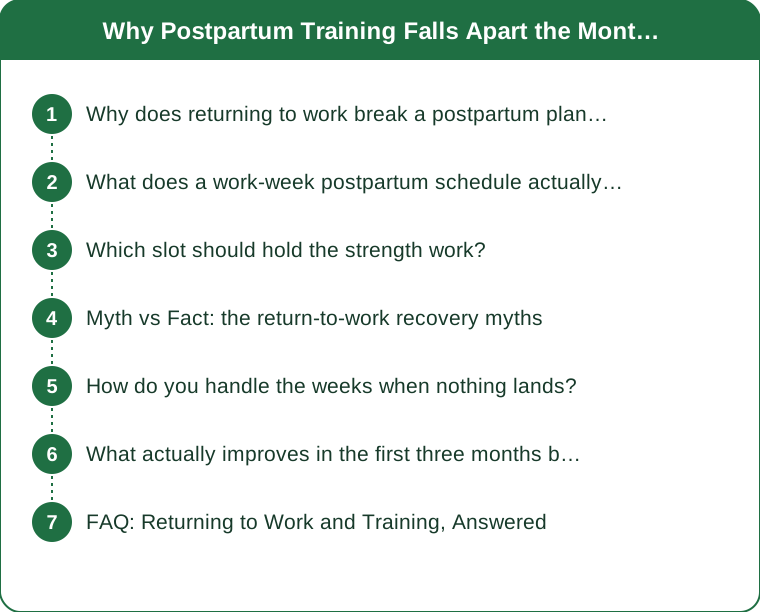
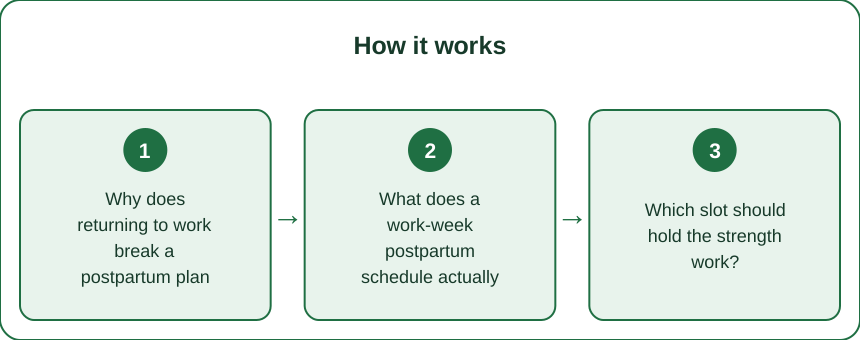
Why does returning to work break a postpartum plan that was working?
Because maternity leave gave you something the plan silently depended on: a movable window. During leave, a session could start at any point in the day. If the 9am attempt failed because of a feed, you tried again at 11, or at 2, or at 4. The plan looked like three sessions a week, but it was actually supported by roughly a dozen possible slots, and you only needed three to land.
Back at work, that dozen collapses to two. There is the window before you leave the house, and the window after bedtime. Everything between is spoken for. So the same three-session target now has to land three times in ten possible slots instead of three times in twelve or fifteen - and those slots are the two most fatigued points of your day.
The arithmetic gets worse when you factor in the commute, the nursery handover, and the fact that the evening window is the first thing sacrificed when the baby wakes early or a work day runs long. In practice most people find that a plan needing three landed sessions gets one or two for a few weeks, reads that as failure, and stops.
None of this is about your recovery. Your pelvic floor and your core did not regress in the last week of leave. The scaffolding changed, and the plan was never rewritten for the new one.
What does a work-week postpartum schedule actually look like?
Start by naming your two anchors honestly, then build around only those. An anchor is a slot that exists whether or not the week goes well. For most people going back to work these are: 20 to 25 minutes before the household wakes, and 20 minutes after bedtime on two named evenings. Not every evening - two specific ones, chosen because nothing else recurs on them.
A workable structure looks like this:
- Anchor A (morning, 3x/week): 20 minutes. Strength and core. This is the slot that gets protected first.
- Anchor B (evening, 2x/week): 20 minutes. Walking, mobility, or a second lighter strength session.
- Opportunistic (0 to 3x/week): 8 to 10 minute blocks. Stroller walks, a set of step-ups while dinner cooks. These are bonus volume, never the plan.
Weekly volume lands around 100 to 140 minutes, which is close to what most three-session-per-week postpartum programs prescribe. The difference is that it is distributed into pieces small enough to survive a bad night.
The common mistake is trying to preserve the 45-minute session because it feels more like real training. A 45-minute session that happens once a fortnight builds less than a 20-minute session that happens three times a week.
Which slot should hold the strength work?
The morning, in almost every case - and the reason is not motivation. By the evening anchor you have accumulated a full work day plus a full evening of carrying, lifting, and bending. Postpartum core and pelvic floor work is technique-dependent, and technique is the first thing that degrades under fatigue. Doing your hardest, most precise work at your most tired point is how form drifts without you noticing.
There is also a compliance argument. The morning slot is protected by the fact that nothing has gone wrong yet. The evening slot competes with the day’s accumulated overruns. Across a month, morning anchors land far more reliably.
If mornings are genuinely impossible - shift work, a baby who wakes at 5, a partner who leaves before you - then invert it, but adjust the load. Evening strength work should sit a little lighter and lean more on controlled tempo than on load or duration.
One practical detail that matters more than it sounds: lay the kit out the night before. Shoes, mat, water, whatever you need, in the room where the session happens. The morning anchor is often lost to a five-minute hunt for a sports bra, and five minutes out of twenty is a quarter of the session.
If you are still in the first twelve weeks postpartum, or you have not been cleared for strength work yet, keep the morning anchor and fill it with breathing and walking instead. The habit is the asset.
One more practical point about the morning anchor: protect it from the phone. The most common way a 20-minute morning slot becomes an 8-minute one is checking email or messages first, discovering something that needs a response, and losing twelve minutes before the mat comes out. Leave the phone in another room until the session is done. It sounds trivial and it is routinely the difference between a slot that holds for three months and one that quietly erodes over three weeks.

Myth vs Fact: the return-to-work recovery myths
Myth: If you were consistent on leave, you will be consistent back at work. Fact: Consistency on leave was partly a function of slot abundance. Losing it is a structural change, not a character change. Expect to rebuild the habit, not just continue it.
Myth: Short sessions are not enough to make progress postpartum. Fact: Weekly volume and progressive load drive adaptation. Three 20-minute strength sessions comfortably clear the threshold for meaningful strength gain in the first year postpartum.
Myth: Going back to work means your recovery is far enough along that you can train normally. Fact: Return-to-work dates are set by policy and finances, not by tissue healing. At twelve weeks, at six months, at a year - the timeline of your recovery is unrelated to your employer’s calendar.
Myth: You should catch up at weekends. Fact: Weekend catch-up sessions are the single most reliable predictor of a plan that will be abandoned by week six. Two big weekend sessions plus nothing midweek produces more soreness, more disruption, and less adaptation than five small distributed ones.
Myth: If you are too tired to train, you should rest. Fact: Sometimes yes. But the tiredness of a working parent with a baby is usually chronic rather than acute, and waiting for it to lift means waiting indefinitely. The useful question is not am I tired but is this fatigue that a 20-minute walk would improve or worsen - and for most days, it improves it.
How do you handle the weeks when nothing lands?
Have a floor, and make it embarrassingly small. Your floor is what you do in a week where illness, a work crisis, or a sleep regression removes both anchors. For most people a good floor is: one 10-minute walk on five days, plus a two-minute breathing and pelvic floor sequence at bedtime.
The floor is not training. It is the thing that keeps the return cheap. Coming back from a floor week takes one session. Coming back from a zero week takes about three weeks, because the habit has to be rebuilt from nothing.
Write the floor down before you need it. Decision-making capacity in a bad week is close to zero, and if the only plan on paper is the full one, the choice becomes all-or-nothing at exactly the moment you are least equipped to make it.
Expect one floor week per month, roughly. In the first year with a baby in nursery, illness alone accounts for a lot of them. A plan that assumes twelve clean weeks per quarter is not a plan, it is a wish. Build for nine good weeks and three floor weeks, and a quarter still produces real progress.
When you come back from a floor week, do not resume where you left off and do not restart from the beginning. Repeat the last week you completed properly, then continue.
What actually improves in the first three months back?
Set your expectations by the right metric, or you will misjudge progress badly. The obvious metrics - weight, session length, how a workout feels - are all heavily distorted by sleep debt and by the fact that you are now doing a job as well.
Better markers for this specific period:
- Load or reps at the same effort. If your goblet squat has gone from 8kg for 8 to 12kg for 8 at the same perceived effort, you have gained strength, whatever the scale says.
- Recovery between sessions. Less next-day stiffness at the same workload is a real adaptation.
- Symptom-free daily loading. Carrying the car seat up the stairs without pelvic heaviness is worth more than any number in a log.
- Landed sessions per fortnight. Track this instead of per week. Weekly counts are too noisy at this stage and make good months look like failures.
What usually does not improve in this window: endurance capacity, because you are not sleeping enough to build it, and body composition, for the same reason plus the hormonal picture if you are still feeding. Chasing either one in the first three months back is the fastest way to end up frustrated and quit.
If you are seeing pelvic heaviness, leaking, or a doming line down your midline during any of this, that is a sign to get assessed by a pelvic health physiotherapist rather than to push through. This is general information, not medical advice.
FAQ: Returning to Work and Training, Answered
How soon after going back to work should I restart structured training?
Give yourself two weeks of nothing but walking and the bedtime breathing sequence. The first fortnight back is a large enough adjustment on its own, and starting a program in the middle of it stacks two hard things together. Restart in week three, with two anchors rather than three.
Is it better to train before work or on my lunch break?
A lunch break sounds ideal and almost never survives contact with reality - meetings run over, and the changing and showering overhead eats most of a short break. If your workplace genuinely supports it and you have a 45-minute clear block, use it. Otherwise the morning anchor is far more reliable.
I am exhausted. Should I be training at all right now?
Probably yes, but less than you think and in a different shape. Twenty minutes of strength work two or three times a week improves sleep quality and daytime energy for most postpartum women. What does not help is intense conditioning on four hours of broken sleep. If you have signs of significant depletion - dizziness, resting heart rate creeping up, mood changes - get bloods checked before adding load.
TL;DR:
- Returning to work removes the flexible daytime slots your leave-era plan quietly depended on - the collapse is structural, not motivational.
- Rebuild around two named anchors, 20 minutes each, rather than three flexible sessions.
- Put strength and core work in the morning anchor where technique holds up best; keep the evening lighter.
- Define a floor week in advance so a bad fortnight costs you one session to recover, not three weeks.
- Judge progress by load at the same effort and by symptom-free daily lifting, not by the scale or by session length.
The month you go back to work is genuinely hard, and it is supposed to feel like that. But the plan that stopped working did not stop because you stopped trying. It stopped because it was built for a different week. Rewrite it for the week you actually have, and it will hold.
See It in Motion
Seen here: Maternity Capris with Side Pockets — shop it on bubblelime.com
Keep Reading
This article is for general informational and styling purposes only. Fit, sizing, and product availability may vary.