Postpartum Swelling: Why It Happens and How to Ease It Safely

Quick Answer: Postpartum swelling usually peaks 2–3 days after birth — later than you’d expect — because pregnancy fluid plus any labour IV fluids all need to clear at once. It typically resolves over 1–2 weeks. Move little and often, elevate your feet above heart level, keep drinking water, and ease off very salty food. Call your provider for sudden or one-sided swelling, or swelling with a bad headache, vision changes, or trouble breathing.
Nobody warns you that you might leave the hospital puffier than you went in.
Day two or three, your ankles look like someone inflated them, your rings won’t move, and your feet have gone up half a size overnight. It feels like something is going backwards.
It usually isn’t. It’s the fluid bill from nine months of pregnancy, plus whatever went into your arm during labour, all coming due at the same time.

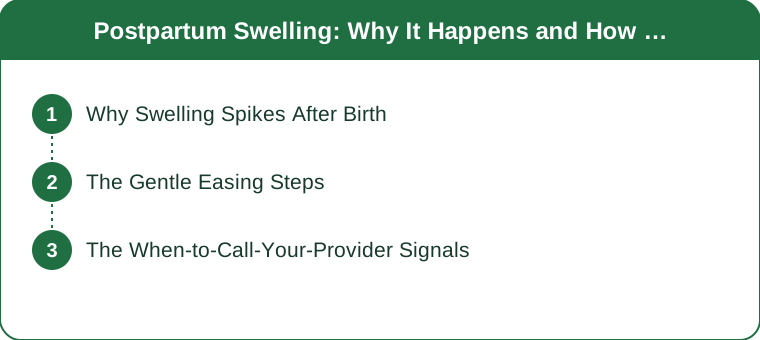
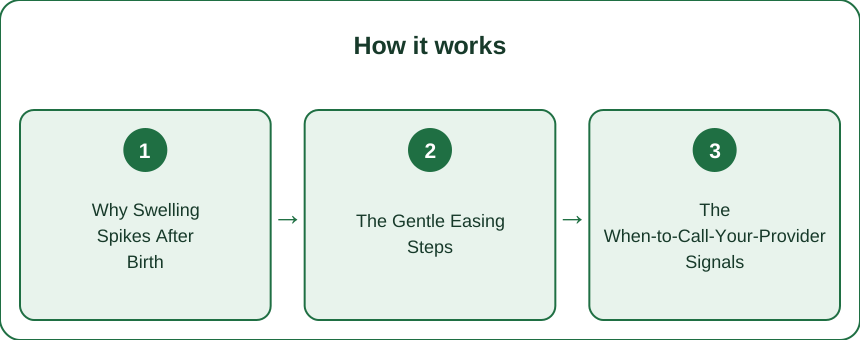
Why Does Swelling Get Worse After Birth, Not Better?
Four things stack up at once:
The fluid you were already carrying. Your body held a substantial extra volume of fluid through pregnancy. Delivery doesn’t flush it — it just removes the reason for holding it. Clearing takes days to weeks.
IV fluids from labour. If you had an epidural, an induction, or a c-section, you were given intravenous fluid, sometimes a lot of it. That adds directly to the pool, which is exactly why swelling often peaks on day 2 or 3 rather than immediately.
Gravity plus stillness. You are now sitting or lying down to feed, for long stretches, many times a day. Fluid follows gravity and settles in your hands, ankles and feet. This is the single biggest reason the puffiness parks itself in your lower legs.
The hormone shift. Your body clears the extra fluid by releasing it — which is why the drenching night sweats and the sudden need to pee constantly show up in the first postpartum week. That’s the system working, not malfunctioning.
The reframe: this is a normal, temporary redistribution, not something to fight. It’s something to support.
What Actually Helps Postpartum Swelling Go Down?
Move a little, often. This is the highest-value habit, and it isn’t exercise. Ankle circles — 10 in each direction, a few times an hour while you feed — pump fluid back out of your legs via the calf muscle. Short walks around the house do the same. Frequency beats duration here.
Elevate when you rest. Feet propped above heart level for 15–20 minutes, a few times a day, lets gravity work in your favour instead of against you. Feeding time is the obvious slot — a pillow under your calves while you’re on the sofa counts.
Keep drinking water. The counter-intuitive one: dehydration makes your body hold fluid. Drinking well signals there’s no shortage, so it releases more. If you’re breastfeeding you need extra anyway — keep a bottle where you feed.
Ease the salt, don’t slash it. Very salty processed food worsens puffiness. But this is not a moment for restriction — you’re recovering and possibly feeding a baby. Balanced eating with less ultra-processed food, not a low-sodium crusade.
Wear loose and supportive. Tight elastic bands at the ankle, wrist or waist trap fluid behind them. Soft, non-binding clothing and supportive shoes with room to spare — your feet may genuinely be a half size larger for a while, and some of that is permanent.
Cool it. A cool compress on hands or feet, or simply keeping the room from being too warm, reduces the puffy, tight feeling. Heat makes it worse.
Compression, if your provider suggests it. Graduated compression stockings help some women considerably, particularly after a c-section. Ask before buying — they’re not right for everyone.
Patience. For most women, the bulk of it clears in one to two weeks.
Myth vs Fact
Myth: Drinking less water reduces swelling. Fact: The opposite. Dehydration triggers fluid retention. Drinking normally to generously helps you clear it faster.
Myth: Swelling means you did too much. Fact: Day 2–3 swelling is driven by fluid volume and hormones, not activity. In fact, gentle frequent movement reduces it — it’s stillness that lets fluid pool.
Myth: Compression socks are always a good idea. Fact: They help many women, but they’re a medical garment. Ask your provider, especially if there’s any question about a clot.
Myth: All postpartum swelling is harmless. Fact: Most is. But sudden, one-sided, or symptom-paired swelling can signal a clot or postpartum preeclampsia — both of which are emergencies. Which brings us to the part that actually matters.
When Should You Call Your Provider About Swelling?
Don’t sit on any of these. Postpartum preeclampsia and blood clots are both real, both occur after delivery, and both are treatable when caught early.
Call promptly or seek urgent care if you have:
- Sudden swelling, or swelling much worse in one leg, especially with pain, warmth, tenderness or redness in the calf — this can indicate a blood clot.
- Swelling with a severe headache, vision changes (blurring, spots, light sensitivity), or pain in your upper right belly — signs of postpartum preeclampsia, which can appear days to weeks after birth even if your blood pressure was fine in pregnancy.
- Chest pain or shortness of breath with swelling — seek emergency care immediately, do not wait.
- Facial or hand swelling that comes on rapidly.
- Swelling that’s getting worse past two weeks instead of easing, or isn’t improving at all.
You know your body better than anyone reading a chart. If something feels wrong, calling is always the right move — nobody at your clinic will think you overreacted.
FAQ
How long does postpartum swelling last?
For most women, the bulk of it clears within one to two weeks, with the peak around day 2–3 after birth. Some mild puffiness in the feet can linger a few weeks longer, especially in hot weather or if you’re on your feet a lot. Swelling that worsens after two weeks should be checked.
Is postpartum swelling worse after a c-section?
Often yes, because c-sections typically involve more IV fluid and more time spent lying still afterwards. The same measures apply — frequent ankle circles, elevation, hydration — just scaled to what your recovery allows. Ask your care team when you can start moving around more.
Why are my feet still bigger months after birth?
Some of it is residual fluid, but pregnancy hormones also relax the ligaments in your feet, which can flatten the arch slightly and permanently increase shoe size by up to half a size. If it’s been months and the swelling is gone but the size change remains, that’s usually structural rather than fluid.
TL;DR:
- Swelling often peaks on day 2–3, from pregnancy fluid plus labour IV fluids, and usually clears in 1–2 weeks.
- Move little and often — ankle circles while feeding beat one long walk.
- Elevate feet above heart level, 15–20 minutes, a few times a day.
- Drink normally — dehydration makes you hold more fluid.
- Ease very salty food, wear loose and supportive clothing, keep cool.
- Call your provider for sudden or one-sided swelling with pain, or swelling with headache, vision changes, chest pain or breathlessness.
See It in Motion
Seen here: Maternity Capris with Side Pockets — shop it on bubblelime.com
Keep Reading
This article is for general informational and styling purposes only. Fit, sizing, and product availability may vary.