The Baby-Carrying Slouch: Fixing New-Mom Posture One Feed at a Time

Quick Answer: Four fixes handle most new-mom posture pain: bring the baby up to your chest with pillows rather than folding down to her, switch hip sides deliberately on every carry, push the stroller standing tall with the handle around belly-button height, and do a two-minute doorway chest stretch daily.
Nobody warns you that a seven-pound human comes with a posture tax.
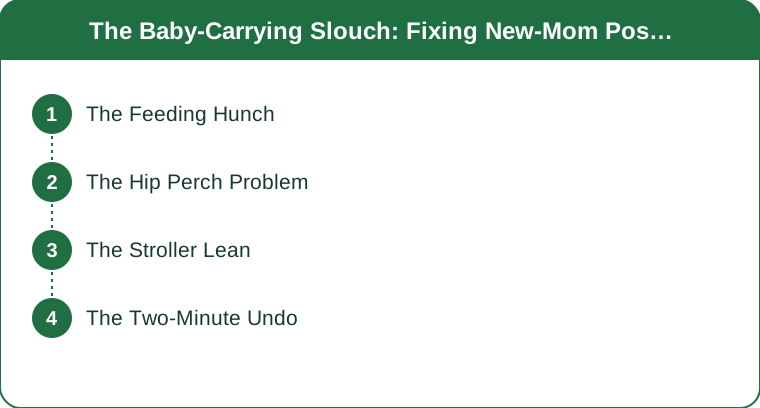
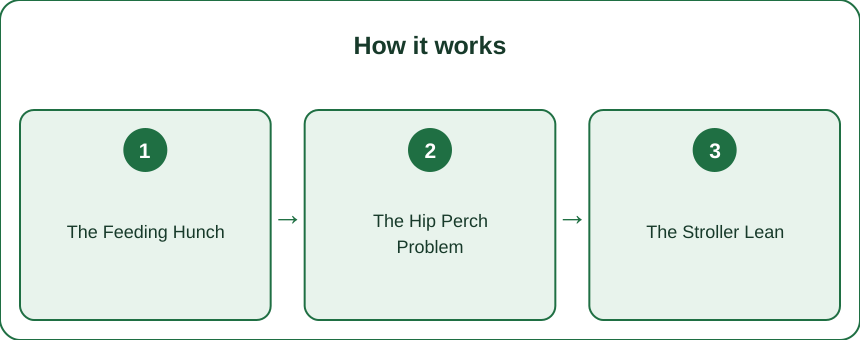
The feeding hunch. The one-hip perch. The stroller lean where you’re basically pushing a walker. Eight weeks in, your upper back has developed opinions and it’s expressing them at 3 a.m.
The good news: the fixes are small, they stack, and none of them require putting the baby down. (She has opinions about that too.)

How do I stop hunching while feeding?
Bring the baby to your chest, not your chest to the baby. That single sentence covers about 80% of it.
The default failure mode is folding forward — head down, shoulders rounded, back curved — for 20 to 40 minutes, eight to twelve times a day. That can add up to five or more hours a day held in flexion, which is why the neck and upper back complain first.
The setup that fixes it:
- Pillows are staff, not decoration. Stack them under the baby until she’s at chest height. Two or three, more than feels reasonable.
- Support your feeding-arm elbow with another pillow or the chair arm so your shoulder isn’t holding the load.
- Sit back into the chair, not perched forward on the edge.
- Feet flat on the floor or on a low stool, so your pelvis isn’t tipping.
- Head level. If you want to look at her — and you will — tip the eyes down, not the whole neck.
Every feed spent propped tall instead of folded forward is a small deposit in the no-neck-pain account. And at ten feeds a day, the deposits compound quickly in either direction.
Night feeds are the hardest to do well. If you’re feeding in bed, get pillows behind your back so you’re genuinely upright rather than half-reclined and curled.
What’s wrong with carrying the baby on one hip?
Nothing, except that nobody does it evenly.
The one-hip perch is genuinely efficient — it frees a hand and the baby’s weight sits on your pelvis. The problem is that almost everyone has a dominant side and uses it 90% of the time. That means one hip hikes, the opposite shoulder drops, the spine curves laterally, and the same set of muscles works while the other set switches off. Repeated for months.
The fixes:
- Switch sides on a schedule, not on instinct. Instinct always picks the same side. Make it a rule — alternate every carry, or every diaper change, or every room you walk into.
- Use a carrier for anything longer than a few minutes. Front-and-center distributes the weight symmetrically, which is what your spine actually wants. A well-fitted soft carrier or wrap solves the problem entirely.
- When you do perch, keep the hip level. Engage the glute on the standing side rather than letting the hip pop out.
Your hips prefer equal-opportunity employment. And the non-dominant side feeling awkward is exactly the evidence that it needs the reps.

How should I push a stroller?
Standing tall, behind it — not leaning over it.
The stroller lean happens because handles are often set low and it’s easy to end up using it for support. The result is a walk spent hunched, with the shoulders forward and the arms locked out.
Correct it:
- Handle height at roughly belly-button level. Adjust it if your stroller allows; most modern ones do, and most people have never touched the setting.
- Elbows soft, bent slightly, close to the body. Locked-out arms push the shoulders up and forward.
- Walk close to the stroller, not stretched out behind it.
- Shoulders back and down, chin level, eyes up.
The stroller is not a walker. Stand up and let it roll — it has wheels precisely so you don’t have to lean on it.
Bonus: walking tall turns the daily stroller loop into actual exercise. Upright walking recruits the core and glutes; hunched shuffling recruits almost nothing. Same 30 minutes, meaningfully different result — and comfortable high waist leggings with real support make it considerably easier to stand tall for the whole loop.
What’s the two-minute daily undo?
One short routine, done once a day, balances hours of baby-shaped curling.
While the coffee reheats for the third time:
-
Doorway chest stretch — 30 seconds each side. Forearm on the door frame at shoulder height, elbow bent 90 degrees, step forward gently until you feel a stretch across the chest. This directly opens what the feeding hunch closes.
-
Ten shoulder rolls. Up, back, and down. Slow and full-range.
-
Ten chin tucks. Gently draw the chin straight back, making a double chin, hold for 3 seconds. Undoes forward head position — the thing that makes the neck ache.
-
Fifteen band pull-aparts, if you have a band. Arms straight, pull outward until the band meets your chest. The single best exercise for rounded shoulders.
Total: about two minutes. Attach it to something that already happens every day — the coffee, the first nap, the moment the baby goes down at night — so it isn’t a decision you have to make.
Consistency matters far more than duration here. Two minutes daily beats twenty minutes once a week, comfortably.
What Nobody Tells You
Relaxin is still in your system. The hormone that loosened your ligaments for birth stays elevated for months, and longer if you’re breastfeeding. Joints are more mobile and less stable than usual, which makes poor posture more consequential and makes aggressive stretching a bad idea. Gentle is the correct setting.
Your core is not the core you had. Abdominal muscles are stretched and weakened, so the trunk support you’re used to isn’t there yet. That’s a large part of why everything else has to work harder — and why rebuilding deep core strength gradually helps posture more than any single stretch.
Carrying gets heavier, not lighter. The baby will roughly double her birth weight by five or six months. The habits you build now are being built for a load that keeps increasing.
Wrist pain is extremely common and often ignored. “Mommy thumb” — de Quervain’s tenosynovitis — comes from the repeated lifting position with the thumb extended. Scoop with flat hands under the torso rather than gripping under the arms.
FAQ
How long does postpartum back pain last?
It varies widely. Pain related to posture and carrying often improves within weeks once the setup changes and some strength returns. Pain that persists beyond three months, worsens, or doesn’t respond to these adjustments deserves assessment.
Are these exercises safe right after birth?
The stretches and chin tucks are gentle and generally fine early on. Anything more — including core work — should wait for your postpartum check-up clearance, typically around six weeks, and longer after a C-section. Talk to your provider before starting any exercise program, and ask specifically about diastasis recti, which affects what core work is appropriate.
When should I see a professional?
See your physician or a pelvic health physical therapist if you have: pain that radiates down a leg, numbness or tingling, pain that wakes you at night, any leaking of urine, a visible bulge or doming down your midline when you sit up, pelvic pressure or heaviness, or pain that isn’t improving after a few weeks. Postpartum physical therapy is routine in many countries and underused in others — it’s worth asking for rather than waiting to see if things resolve.
Does babywearing help or hurt posture?
Helps, when the carrier is fitted properly — the weight sits symmetrically and close to your center of gravity. It hurts when the carrier is loose and the baby hangs low, which pulls you forward. Get it fitted once, properly; many stores and lactation consultants will help, and the difference is substantial.
TL;DR:
- Feeding: bring the baby up with pillows, support the elbow, keep the head level
- Carrying: switch hip sides on a schedule; use a carrier for anything longer than a few minutes
- Stroller: handle at belly-button height, elbows soft, stand tall and let it roll
- Two-minute daily undo: doorway chest stretch, shoulder rolls, chin tucks, band pull-aparts
- Relaxin keeps joints loose for months — gentle, not aggressive
- See a professional for radiating pain, numbness, leaking, midline doming, or pain that isn’t improving
You can’t opt out of carrying the baby. But you can carry her tall, switch hips like a diplomat, and un-hunch daily.
See It in Motion
Seen here: Maternity Capris with Side Pockets — shop it on bubblelime.com
Keep Reading
This article is for general informational and styling purposes only. Fit, sizing, and product availability may vary.