Cold Season and Your Pelvic Floor: Why One Bad Cough Undoes Six Weeks of Progress

Quick Answer: A hard cough spikes downward pressure on your pelvic floor far past anything in your workout, and doing it two hundred times a day for a week can absolutely undo weeks of quiet progress. The fix is not resting until you are better. It is bracing every cough, dropping impact for that week, and rebuilding in a specific order once the cough clears.
Daycare started. Preschool started. Somebody in your house is coughing, and by Thursday it is you.
Then you sneeze in the kitchen and feel that unmistakable little betrayal, the one you thought you were done with in June. It is not a relapse of your whole recovery. It is a load problem, and load problems have answers.

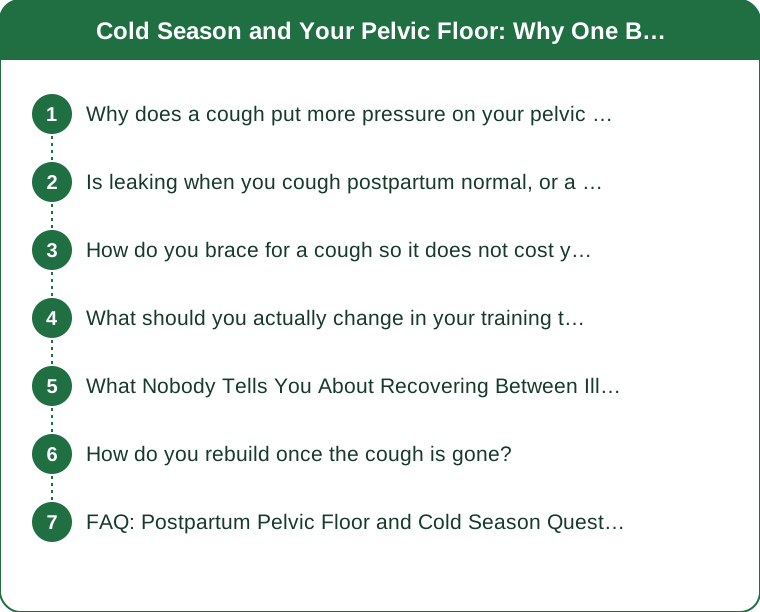
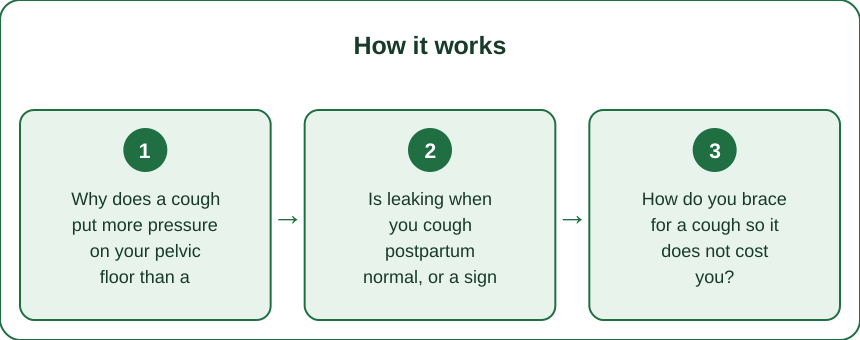
Why does a cough put more pressure on your pelvic floor than a workout?
Your pelvic floor sits at the bottom of a pressurized canister. The diaphragm is the lid, the deep abdominals are the walls, the pelvic floor is the base. Anything that raises pressure inside that canister pushes down on the base.
A cough is the single most aggressive pressure spike most people generate in a normal day. Researchers measuring intra-abdominal pressure consistently find coughing and sneezing outrank heavy lifting, jumping and sit-ups. A cough is fast, it is unbraced, and it happens when you are least prepared for it.
Now multiply. A moderate cold gives you 100 to 300 coughs a day for five to ten days. That is potentially two thousand max-effort pressure spikes landing on tissue that is still remodeling. Compare that to your workout, where you might do forty controlled reps with a braced core.
There is a second layer people miss. A cough is not only a pressure spike, it is a pressure spike your pelvic floor almost never gets to prepare for. In training, you know a heavy set is coming. You set your feet, you take a breath, you brace. A cough arrives from a tickle in your throat two hundred milliseconds before it happens, and your reflexive pelvic floor contraction is exactly the thing that is slower and less coordinated in the first postpartum year.
Add the position you cough in. Most coughing happens seated, hunched over, or lying down at night, all positions where your ribcage is compressed and your diaphragm has less room to move. That pushes more of the pressure downward rather than allowing it to distribute.
This is why the maths of postpartum recovery gets confusing. You did everything right for six weeks, then a virus came through the house and your symptoms came back. Nothing about your training was wrong. The dosing of everything else changed underneath you.
Is leaking when you cough postpartum normal, or a sign something is wrong?
Common and normal are different words. Stress urinary incontinence, leaking with a cough, sneeze, laugh or jump, affects roughly a third of women in the first year after birth. Common. It is not, however, something you are meant to live with permanently, and it is not something that reliably fixes itself with time alone.
Here is the useful distinction. Leaking only during a cold, when you are coughing dozens of times an hour, is a load problem. Your system is being asked to manage far more pressure than usual. Leaking on a normal day with a single sneeze, or during a walk, or every time you pick up your toddler, is a capacity problem and deserves a pelvic health physiotherapist.
Watch for a few things that move it out of the wait-and-see category regardless of cause: a heaviness or dragging feeling in the vagina, especially by the end of the day; leaking stool or struggling to control gas; pain with sex that is not improving; or symptoms that are getting worse week over week rather than better. Any of those, book the appointment. This is general information, not medical advice.
One more distinction is worth having, because it changes the plan entirely. Some people leak because the pelvic floor is not generating enough force quickly enough, and some leak because it is already so tight and overworked that it has nothing left to add. The second group is larger than most people assume, and it is the group that gets worse doing hundreds of Kegels a day. If your pelvic floor feels permanently gripped, if you have pain rather than weakness, or if a month of diligent strengthening has made no difference at all, stop guessing and get an internal assessment. It is a fifteen-minute answer to a question you cannot resolve from the outside.
How do you brace for a cough so it does not cost you?
This is the single highest-value thing in this article, and almost nobody is taught it. You can dramatically reduce the pressure that reaches your pelvic floor by preparing for the cough instead of absorbing it.
It is called the knack, and it is one move: just before you cough or sneeze, lift your pelvic floor and gently draw your lower belly in, then let go afterwards. Think of a quick, light elevator-up rather than a hard clench. Time it with the inhale you take before the cough, because you always take one.
Three additions that stack on top:
- Turn your head and cough over your shoulder. Twisting slightly reduces straight-line downward force.
- Sit or brace a hand on a counter during a coughing fit rather than standing unsupported.
- Cross your legs. It sounds like a joke. It measurably reduces leaking during a cough and it is free.
For a real cold, practice the knack on the first day, before you are exhausted. By day three you want it automatic, because that is when the fits get long and your attention is gone.
Two things reduce the total number of coughs, which matters as much as managing each one. Treat the cough itself rather than enduring it: steam, honey, fluids, and a word with your pharmacist about a suppressant for night-time, because the 2am coughing fits are the ones that do the most damage on the least sleep. And prop yourself up on an extra pillow to sleep, since lying flat pools postnasal drip and triggers longer fits.
Sneezing deserves its own note. A sneeze is faster than a cough and gives you almost no warning, but you do get the pre-sneeze breath. Use it. Lift, turn your head, and let it happen. Never try to stifle a sneeze by pinching your nose and closing your mouth, which redirects that entire pressure spike inward.

What should you actually change in your training that week?
Not everything. The instinct is to stop entirely, and that costs you more than it saves. Here is the swap.
Pull out for the week: running, jumping, plyometrics, double-unders, any impact at all. Also heavy loaded carries, max-effort lifting, and anything where you hold your breath and strain. Your pressure budget for the week is already spent on coughing.
Keep in: walking, at whatever pace feels fine. Bodyweight lower-body work, squats to a chair, glute bridges, step-ups, side-lying hip work. Upper body with moderate weight and clean exhale-on-effort breathing. Mobility. All of it helps circulation and mood, and none of it stacks meaningfully on top of the coughing.
Add in: exhale-on-effort as a rule, not an option. Breathe out through the hard part of every rep. And two to three short sessions of diaphragmatic breathing, five minutes lying on your back with knees bent, hand on ribs, feeling the ribcage widen sideways on the inhale and the pelvic floor gently release. Your diaphragm has been working overtime; it gets tight and stops coordinating with the pelvic floor, and the result feels like weakness when it is actually a coordination fault.
One practical rule: if you leak during an exercise, that exercise is too much today. Not forever. Today.
What Nobody Tells You About Recovering Between Illnesses
The postpartum recovery literature assumes an uninterrupted runway. Real life with a child in daycare offers you about eleven days.
Here is what that actually means, and none of it is in the six-week checkup.
You will get sick more often than you ever have. A first-year daycare child brings home eight to twelve viruses a year. You catch a good share of them. Your training year is not twelve months of progression, it is a series of two-to-three week blocks with disruptions between them. Plan in blocks, not in a straight line.
Fragmented sleep amplifies everything. Tissue remodeling happens in deep sleep. A week of broken nights while sick means less repair capacity exactly when demand peaked.
The week after the cough stops is the risky one. You feel human again, you are behind, and you go straight back to the running you were doing before. That is where the setback becomes a real injury. Give yourself three to five days of the rebuild sequence first.
Chronic coughs deserve treatment. A cough that drags past three weeks is not just annoying, it is an ongoing pelvic floor load. Get it looked at as a pelvic floor issue as much as a chest one.
And the one that surprises people: stress incontinence during illness predicts nothing about your long-term outcome. Women who leak through every cold in year one routinely have no symptoms at all by year two. The temporary spike is not the trajectory.
How do you rebuild once the cough is gone?
Give it a structure so you are not guessing. Roughly five days, adjusted to how you feel.
Day 1 to 2. Reconnect. Two sessions a day of diaphragmatic breathing with pelvic floor contractions layered on the exhale. Ten slow lifts, holding three seconds each, plus ten quick ones. Then a full release. Walking, 20 to 30 minutes, easy.
Day 3. Load without impact. Glute bridges, 3 sets of 10. Chair squats, 3 sets of 8. Side-lying leg lifts, 2 sets of 12 each side. Dead bug variations, keeping the ribs down. Exhale on the effort of every single rep.
Day 4. Test. Ten heel raises, ten small hops in place, thirty seconds of jogging on the spot. No leaking, no heaviness, no dragging feeling means green light. Any of those three means back to day 3 work for another two days, no negotiation.
Day 5 onward. Return at 60 percent. If you were running 30 minutes before you got sick, run 18. Add ten percent per session from there. You will get back to where you were in about ten days, and you will get there without another setback.
Skipping this sequence is what turns a one-week interruption into a six-week one.
FAQ: Postpartum Pelvic Floor and Cold Season Questions, Answered
Can coughing cause prolapse after birth?
Repeated heavy coughing is a recognized risk factor for pelvic organ prolapse, particularly in the first postpartum year when connective tissue is still recovering. It is far more relevant with a chronic cough over weeks than a single ordinary cold. If you feel persistent heaviness, dragging, or a bulge sensation, see a pelvic health physiotherapist or your doctor rather than waiting it out.
Should I do Kegels while I have a cold?
Yes, and specifically the timed kind. Practicing the knack, lifting just before each cough, is more useful right now than a set of thirty repetitions on the couch. Add a few minutes of gentle contract-and-fully-release work daily. Skip long, hard, maximal holds while your system is fatigued; a pelvic floor that cannot relax is as problematic as one that cannot lift.
How long after being sick should I wait to run again?
Not a fixed number, a test. Once the cough has been gone for 48 hours, run the impact check from the rebuild section: heel raises, small hops, thirty seconds of jogging in place. Clear on all three and you can start at about 60 percent of your previous volume. Most people are two to five days post-cough. Do not use how much energy you have as the signal, because energy comes back before tissue tolerance does.
TL;DR:
- A cough generates a bigger downward pressure spike on your pelvic floor than almost anything in your workout, and a cold delivers hundreds of them a day.
- Use the knack: lift the pelvic floor and gently draw the belly in right before each cough or sneeze, then release. Cough over your shoulder and cross your legs during fits.
- Pull impact and heavy straining for the week, keep walking and bodyweight work, exhale on effort, and add diaphragmatic breathing.
- Rebuild in a sequence over about five days and pass a small impact test before running again.
None of this means your recovery went backwards. It means the demand went up for a week while your capacity stayed the same, and that gap is entirely manageable once you can see it. Protect the tissue while the coughing lasts, rebuild deliberately when it stops, and get symptoms that outlast the cold assessed properly.
See It in Motion
Seen here: Maternity Capris with Side Pockets — shop it on bubblelime.com
Keep Reading
This article is for general informational and styling purposes only. Fit, sizing, and product availability may vary.