Why Your Postpartum Core Feels Fine Standing But Fails the Second You Cough or Sneeze

Quick Answer: Standing core strength and the split-second core reflex that fires during a cough or sneeze are trained differently — you can rebuild one without the other. A sneeze catching you off guard even after your plank feels solid usually means the reflex, not the strength, still needs work.
Your plank hold is back. Your walks feel strong. Then you sneeze in the grocery store line and there it is — that same old give in your core you thought you’d fixed months ago. Nothing about that is a setback. It’s a different system entirely.

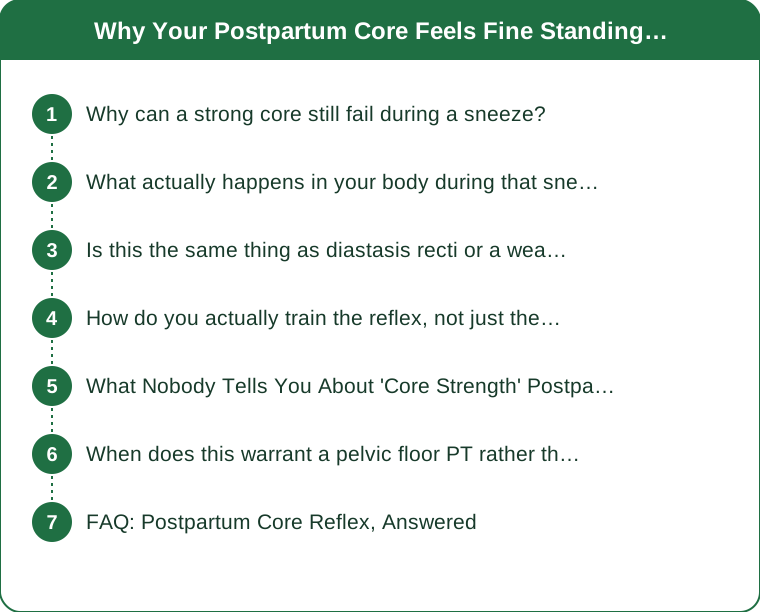
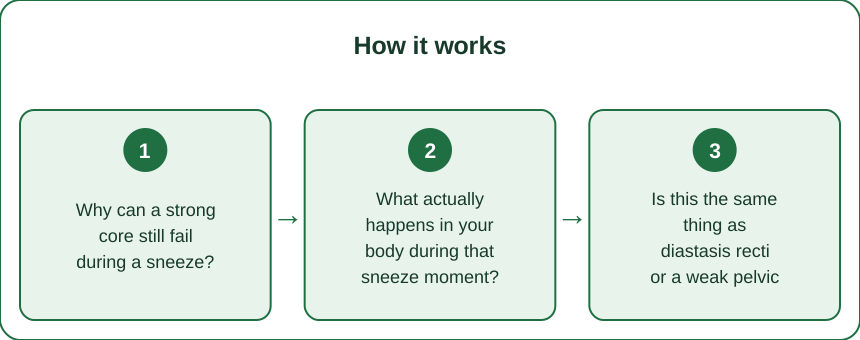
Why can a strong core still fail during a sneeze?
A held plank trains sustained, predictable core tension — you brace, you know it’s coming, your nervous system has time to organize the right muscles in the right order.
A sneeze or cough is unpredictable, explosive intra-abdominal pressure — 0.2 seconds from zero to maximum, with no warning. That requires a reflexive brace, not a planned one, and reflexive bracing is a separate motor pattern your body has to relearn after pregnancy, regardless of how strong your planned core work has become.
What actually happens in your body during that sneeze moment?
A sneeze can spike intra-abdominal pressure dramatically higher than a controlled exhale, all downward and outward against your pelvic floor and deep abdominal wall in a fraction of a second.
Before pregnancy, your deep core (transverse abdominis, pelvic floor) fired automatically, milliseconds ahead of that pressure spike, because the neural pathway was well worn. Pregnancy and birth interrupt that timing — the muscles may have the strength back, but the automatic, pre-emptic firing pattern often lags behind, which is exactly the gap that shows up as a leak, a bulge, or that ‘give’ feeling.
Is this the same thing as diastasis recti or a weak pelvic floor?
Related, but not identical. Diastasis and pelvic floor weakness are about tissue and muscle capacity. This reflex gap is about timing — whether your core fires early enough and fast enough, independent of how much raw strength is available.
That’s why some people with excellent measured pelvic floor strength on a clinical test still leak with a sneeze: the muscle can do the job, it’s just arriving late to the party.

How do you actually train the reflex, not just the strength?
Unpredictable-timing drills, not more planned bracing:
- The surprise cough drill: Have a partner say ‘now’ at random intervals while you’re mid-conversation, distracted; brace on the cue as fast as possible. Simulates the unpredictability a real sneeze has.
- Pre-emptive brace on your own cough: Since you usually feel a cough or sneeze coming a half-second early, practice consciously bracing in that half-second — this trains the habit of pre-firing until it becomes automatic again.
- Dynamic movement + surprise load: Walking while someone unexpectedly (gently) nudges you off balance retrains reflexive core response in a way that static planks never will.
What Nobody Tells You About ‘Core Strength’ Postpartum
Most postpartum fitness content measures success by hold time or rep count — and those numbers genuinely matter for capacity. But almost none of it addresses reflex timing, which is precisely the piece that determines whether a sneeze, a laugh, or a jump on a trampoline with your toddler catches you off guard.
This is why some people feel ‘recovered’ by every strength metric and still get surprised by a cough. It’s not a contradiction — it’s a genuinely separate skill that standard core programs rarely train directly.
When does this warrant a pelvic floor PT rather than home drills?
If leaking happens with every cough or sneeze (not occasionally), if there’s pelvic pressure or a visible bulge, or if it’s been more than a year postpartum with no improvement despite consistent practice, that’s beyond a reflex-timing gap you can drill your way out of alone.
A pelvic floor physical therapist can assess whether the issue is timing, strength, tissue tension, or a combination — and build a plan specific to what they find, rather than guessing from drills alone. This is general information, not medical advice.
FAQ: Postpartum Core Reflex, Answered
How long does it take to retrain this reflex?
Most people notice improvement within 3-4 weeks of consistent surprise-timing drills done a few times a week — faster than most people expect, since it’s a neural retraining, not a strength-building timeline.
Does this get better on its own without specific drills?
Sometimes partially, especially in the first year, but the specific unpredictable-timing gap often needs deliberate practice — general core strengthening alone doesn’t automatically transfer to reflex speed.
Is it normal to still have this a year or more postpartum?
It’s common but not something to just accept indefinitely — since the drills are quick and low-effort, most people find it worth addressing rather than working around it forever.
TL;DR:
- Standing core strength and the reflexive brace needed for a sneeze are two different, separately trained systems
- A sneeze spikes pressure in a fraction of a second — too fast for a ‘planned’ brace to help
- Train the reflex with unpredictable-timing drills (surprise cough cues, pre-emptive bracing), not more planks
- Leaking with every cough, visible bulging, or no improvement after a year warrants a pelvic floor PT
A strong plank and a reliable sneeze-brace are both worth having — they just need to be trained separately. This is general information, not medical advice.
See It in Motion
Seen here: Maternity Capris with Side Pockets — shop it on bubblelime.com
Keep Reading
This article is for general informational and styling purposes only. Fit, sizing, and product availability may vary.