The Complete Guide to Diastasis Recti Healing: What Actually Happens Week by Week

Quick Answer: Diastasis recti healing typically unfolds over 8-12 weeks of consistent, correctly-targeted core work for meaningful improvement, though some gap narrowing continues for up to a year. Healing depends far more on exercise selection and consistency than on time alone — the wrong exercises for months can leave the gap unchanged.
Every postpartum forum has a different number attached to diastasis recti healing — 6 weeks, 6 months, ‘it never fully closes.’ The truth is less tidy and more useful: healing is a process with distinct phases, and knowing which phase you’re in changes what actually helps.

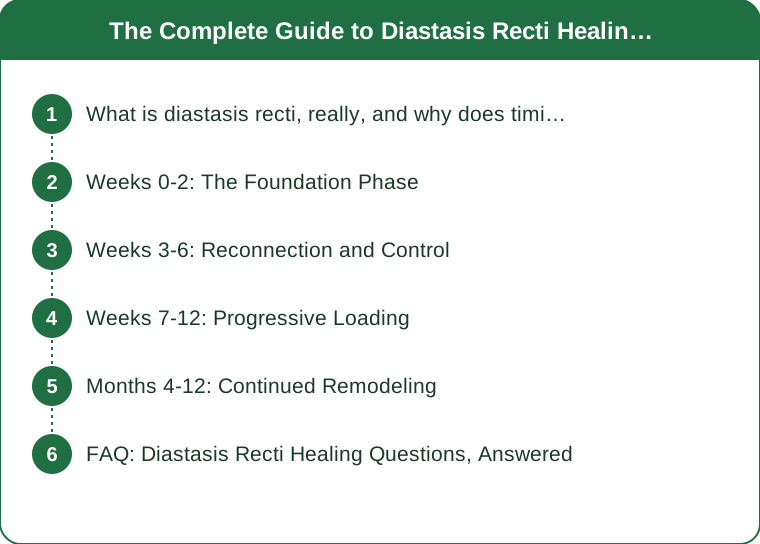
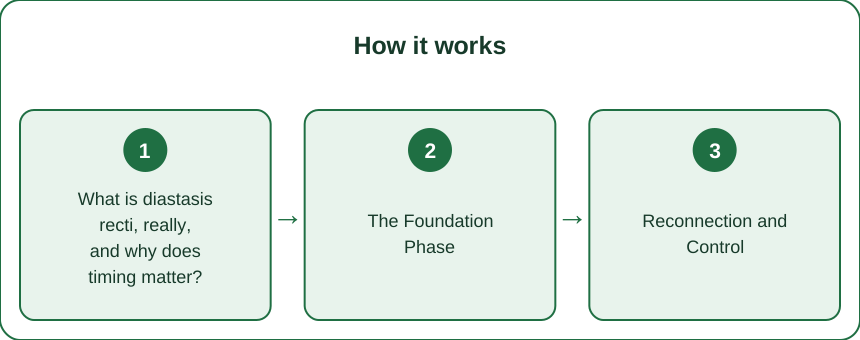
What is diastasis recti, really, and why does timing matter?
Diastasis recti is a separation of the linea alba, the connective tissue running down the center of the abdominal wall, stretched during pregnancy to accommodate a growing uterus. It’s present in the vast majority of pregnancies by the third trimester — it’s not a rare complication, it’s a normal and expected adaptation.
What varies enormously is how much it narrows afterward, and that’s where timing and exercise choice both matter. The tissue has healing capacity, but it responds to the right kind of tension-building work, not to rest alone or to random ab exercises.
Understanding the timeline matters because the interventions that help early on (breathing, gentle engagement) are different from what helps once basic function has returned (progressive loading). Doing week-12 exercises in week 2 can slow things down, and doing week-2 exercises in week 12 can stall progress just as easily.
Weeks 0-2: The Foundation Phase
This phase is almost entirely about breath and gentle engagement, not visible ab work. Diaphragmatic breathing that coordinates with a light pelvic floor and deep core engagement (think: a gentle ‘zip up’ feeling from pubic bone to ribs on the exhale) is the actual foundation everything later builds on.
This is also when to avoid anything that causes visible doming or coning down the midline — that’s a sign of excess intra-abdominal pressure the connective tissue isn’t ready to manage yet. Sit-ups, crunches, and heavy lifting all fall into this danger zone early on.
Progress here is invisible and easy to dismiss, but skipping it is the single most common reason people plateau later — the deep stabilizing system needs to come back online before surface-level strength work can do its job properly.
Weeks 3-6: Reconnection and Control
This is where functional movement patterns start layering on top of the breathing foundation — modified bridges, heel slides, bird-dogs, all performed with continued attention to avoiding doming. The goal shifts from ‘can I engage the core’ to ‘can I keep it engaged through movement.’
Many people notice the gap measurement itself hasn’t changed much yet by week 6, which is normal and doesn’t mean the work isn’t doing anything — tension and control typically improve before the physical gap width does.
This phase is also when clearance for return to general exercise usually happens (around 6 weeks postpartum with provider approval), but ‘cleared for exercise’ doesn’t mean cleared for unmodified ab work. The distinction trips a lot of people up.

Weeks 7-12: Progressive Loading
Once foundational control is solid, this phase introduces more demanding core-integrated movement — planks (modified as needed to avoid doming), loaded carries, squats and deadlifts with proper bracing. This is typically when the gap measurement starts showing more visible narrowing, because the tissue is finally getting the progressive tension stimulus that actually drives remodeling.
This is also the phase where people most often either push too fast (jumping straight to unmodified crunches because ‘it’s been 3 months’) or stay too cautious (still avoiding all core work at week 10 out of fear). Both slow progress in different ways.
Regular reassessment matters here — checking the gap width and depth (a physical therapist can do this, or a careful self-check) every couple of weeks helps confirm the current exercise level still matches where the tissue actually is.
Months 4-12: Continued Remodeling
Connective tissue remodeling continues well beyond the 12-week mark for many people, especially with consistent progressive training. This is the phase where a gap that seemed ‘stuck’ at 2-3 fingers width can continue narrowing gradually with ongoing work.
It’s also normal for some residual gap to remain permanently even with excellent training — the goal past this point often shifts from ‘closing the gap entirely’ to restoring full tension and function, since a small gap with strong tension across it functions very differently than a wide gap with no tension.
Strength, not just gap width, is the more meaningful long-term marker: can the core generate and hold tension under load, is there still doming under stress, is there any lower back pain from compensation.
FAQ: Diastasis Recti Healing Questions, Answered
Can diastasis recti heal without any exercise at all?
Some narrowing can happen naturally in the early months, but a full functional recovery — real tension restoration — almost always requires targeted, progressive core work rather than rest alone.
Is it too late to start diastasis recti exercises years postpartum?
No — many people see meaningful improvement in gap width and function starting a targeted program years after birth; connective tissue retains remodeling capacity well beyond the postpartum window.
When should diastasis recti be evaluated by a professional instead of self-managed?
If there’s persistent doming under light activity, ongoing lower back or pelvic pain, or the gap feels deep and soft rather than firm at the base, a pelvic floor physical therapist can assess more precisely than a home check. This is general information, not medical advice.
TL;DR:
- Healing unfolds in phases: breathing/engagement (0-2wk) → reconnection (3-6wk) → progressive loading (7-12wk) → continued remodeling (4-12mo+)
- Skipping the early breathing/engagement phase is the most common cause of later plateaus
- Gap width often lags behind functional tension improvement — track both, not just the measurement
- Some residual gap can be normal even with strong recovery; functional tension matters more than a fully closed gap
- This is general information, not medical advice — a pelvic floor PT can give an individual assessment
Diastasis recti healing isn’t a race against a deadline — it’s a sequence, and doing the right phase at the right time matters more than doing it fast.
See It in Motion
Seen here: Maternity Capris with Side Pockets — shop it on bubblelime.com
Keep Reading
This article is for general informational and styling purposes only. Fit, sizing, and product availability may vary.