The Complete Guide to Rebuilding Postpartum Strength in Ten-Minute Blocks

Quick Answer: You do not need a forty-minute session to rebuild postpartum strength. Three ten-minute blocks spread across a day produce comparable strength gains to one thirty-minute session, because strength adapts to total quality sets per week rather than to how those sets are packaged. The catch is that short blocks only work if each one has a single job - one lower body pattern, one upper body pattern, or one breathing and pelvic floor piece - and if you keep a simple written record. Aim for 9 to 12 total working sets per week in the first eight weeks, then add one set per week.
The problem is rarely motivation. It is that a baby does not schedule forty uninterrupted minutes, and every plan you find assumes you have them. So here is the plan built the other way round - designed for the ten minutes you actually get.

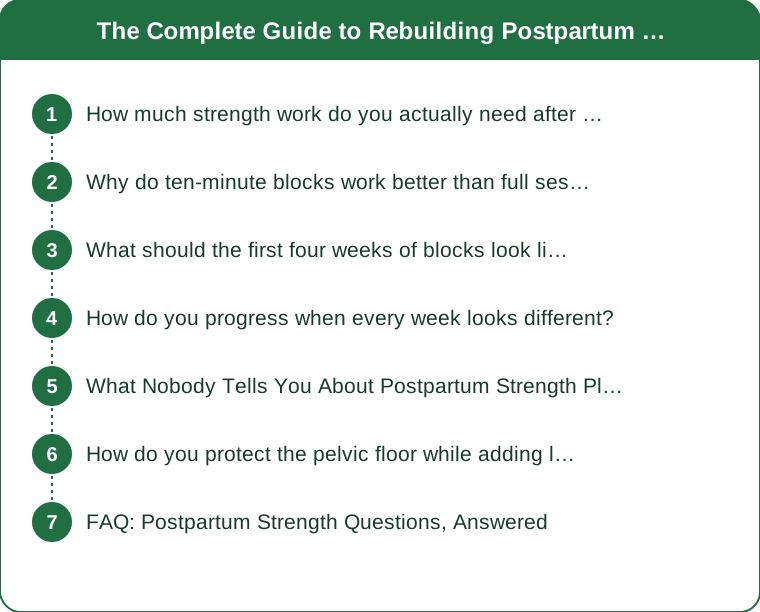
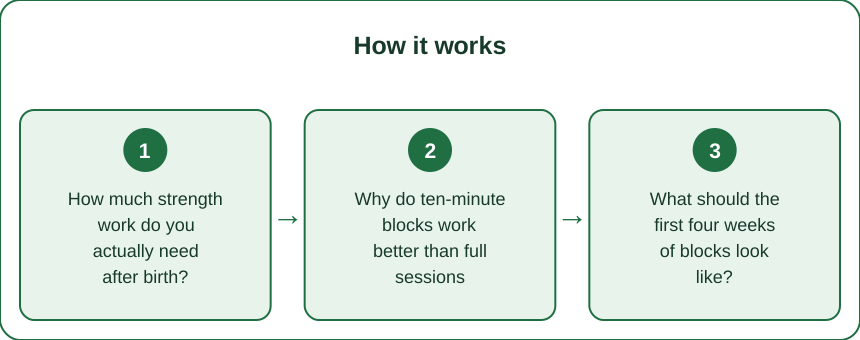
How much strength work do you actually need after birth?
Far less than the standard programme suggests, and that is not a consolation prize. Research on training volume consistently shows that beginners and returning lifters make near-maximal strength gains from roughly 9 to 12 hard sets per muscle group per week, and that returning lifters sit at the low end because previously trained tissue responds quickly. If you trained before pregnancy, you are a returning lifter, not a beginner.
Spread across a week, 12 sets is nothing like as daunting as it sounds. Four sets of a squat pattern, four of a hinge or a row, four of a press, and you have covered the body. At roughly 45 seconds of work and 90 seconds of rest, four sets is under nine minutes. That is the whole insight - the session was never the unit of progress. The set was.
What changes postpartum is not the number but the tolerance. Tissue that has been stretched over nine months and, for many, cut through, does not want its weekly volume delivered in one lump. Splitting the same 12 sets into three or four short exposures gives connective tissue more recovery windows and reduces the intra-abdominal pressure spikes that come from grinding through a long session while tired. Same total, gentler delivery.
Why do ten-minute blocks work better than full sessions postpartum?
Three reasons, and only one of them is about time. The first is the obvious one: a ten-minute window appears several times a day, and a forty-minute one might appear twice a week. A plan that requires the rare window fails on ordinary days.
The second is fatigue management. Postpartum fatigue is not the same as ordinary tiredness - broken sleep degrades force production and, more importantly, degrades your ability to notice when your form has drifted. In a long session, the last third is usually where technique quietly falls apart and where pelvic floor symptoms tend to appear. Ten-minute blocks almost never reach that third.
The third is pressure. Every hard set raises intra-abdominal pressure, and the pelvic floor manages that pressure. Its capacity is not a fixed number - it declines within a session as the tissue fatigues. Short blocks let capacity recover between exposures rather than asking it to hold across forty continuous minutes. In practice this is why women often report heaviness or leaking in the back half of a long session and never in a short one at the same load.
The trade-off is real and worth naming: you lose the cardiovascular conditioning that comes from continuous work, and you lose the psychological satisfaction of a proper workout. The first can be rebuilt later with walking. The second is worth grieving briefly and then setting down.
What should the first four weeks of blocks look like?
One pattern per block, three blocks per day, four days per week. Here is the structure that survives contact with an actual household.
Block A - lower body. Goblet squat or box squat, 3 sets of 8, resting 60 to 90 seconds. Weight should feel like a 7 out of 10 by the last rep, never a 10. If you have no weights, a chair squat with a three-second lowering phase does the job for the first three weeks.
Block B - upper body. Choose one push and alternate weekly with one pull. Incline push-ups against a counter, 3 sets of 8. Or a single-arm row with a milk jug or dumbbell, 3 sets of 8 each side. Counter height push-ups are far more useful than floor push-ups here because they let you keep ribs stacked over pelvis without your midsection sagging.
Block C - breathing and pelvic floor. 5 minutes, no equipment. Side-lying 90-90 breathing for 2 minutes, then 10 slow pelvic floor contractions with full release between each, then 10 quick ones. The release matters more than the squeeze and is the part almost everyone rushes.
Week one, do Blocks A and C only. Week two, add B. Weeks three and four, run all three on four days. That is 9 working sets in week two rising to 12 by week four - exactly the range that produces adaptation.

How do you progress when every week looks different?
Progress the set count first, the load second, and never both in the same week. This single rule prevents most of the frustration.
Keep a note on your phone with three lines per block: date, load, and how the last rep felt on a scale of 1 to 10. That is the entire record-keeping system. When the last rep of your final set feels like a 6 or lower for two sessions running, add either one set or a small load increase - not both.
When a week goes badly - illness, a sleep regression, a growth spurt - do not try to make it up. Repeat the previous week instead. Postpartum training punishes catch-up attempts more than almost any other context, because the missed week usually also means a week of worse sleep, and you would be adding load onto a system that is already depleted.
A useful benchmark: by week eight, most women who trained before pregnancy can hold 3 sets of 10 goblet squats at 8 to 12 kg, and 3 sets of 10 counter push-ups, with the last rep at a 7. If you are well short of that by week eight and nothing is hurting, the usual cause is that the blocks drifted to twice a week rather than four times. Count the blocks before you change the plan.
What Nobody Tells You About Postpartum Strength Plateaus
The plateau at around week ten is almost never a training problem. It arrives with remarkable consistency, and the standard advice - add volume, add load, push harder - is close to the worst possible response.
Here is what is usually happening. Weeks one to eight run on neural adaptation: your nervous system gets better at recruiting muscle you already have, which is fast and feels wonderful. Around week nine or ten that runs out, and further progress requires actual tissue change, which is slower and depends on protein intake and sleep. Both of those are typically at their worst in a postpartum household.
The second hidden factor is that many women are still under-eating at this point, often unintentionally. Breastfeeding adds roughly 400 to 500 calories of demand per day, and appetite cues are unreliable when sleep is broken. A plateau that appears alongside persistent afternoon cold hands and a stalled mood is a fuelling plateau wearing a training costume.
The third: nobody warns you that returning menstruation frequently coincides with a strength dip of a week or so. It is not a setback. It is a Tuesday.
So when week ten flattens out, check food, check sleep, and hold the load steady for a fortnight before touching the programme. The plateau usually resolves itself once one of the other two improves.
How do you protect the pelvic floor while adding load?
Watch for three signals, and treat any of them as a stop sign rather than a warning. Heaviness or dragging in the vagina, leaking, or a visible doming along the midline during effort. Any one of these means the load or the position was wrong for today - not necessarily forever.
The most useful mechanical habit is exhaling on effort. Breathe out as you stand up from the squat, as you press away from the counter, as you row. This coordinates the pelvic floor lift with the moment of highest pressure and costs nothing to learn. If you can only remember one thing from this guide, make it this.
Second habit: keep your ribcage stacked over your pelvis. The postpartum default is ribs flared and pelvis tipped forward, which puts the pelvic floor at a mechanical disadvantage before the set even starts. A hand on the lower ribs during the first set of each block is enough to check.
Third: treat symptoms as load-dependent, not permanent. Heaviness at 12 kg does not mean you cannot squat. It means today, at this level of fatigue, 12 kg was too much - drop to 8 kg and it usually disappears.
If symptoms persist at any load, or if you have pain rather than heaviness, see a pelvic health physiotherapist. This is general information, not medical advice, and a single assessment often resolves in twenty minutes what months of guessing will not.
FAQ: Postpartum Strength Questions, Answered
Can I start ten-minute blocks before six weeks?
Block C - breathing and pelvic floor - is appropriate from the first week for most uncomplicated births, and many clinicians encourage it. Loaded blocks A and B generally wait for your postnatal check. After a caesarean, the timeline is longer and should be set by your clinician rather than by a calendar.
Is three ten-minute blocks really as good as one thirty-minute session?
For strength, yes, provided the total working sets match and each set is genuinely hard. For cardiovascular fitness, no - continuous work has an advantage there. Most postpartum women are better served by getting strength through blocks and conditioning through walking.
Should I be doing core work, or does that make separation worse?
Doing nothing is what makes it worse. What matters is choosing exercises where you can keep the midline flat and breathe. Side-lying work, dead bugs with a small range, and loaded carries are usually well tolerated. Full sit-ups and front planks tend to be the ones that dome, so they wait.
What if I can only manage one block a day instead of three?
One block a day, four days a week, still puts you at roughly 12 sets per week if you rotate the patterns - which is the whole target. The trade-off is that each pattern gets trained less often, so progress is slower but not absent. Rotate A, B, A, C across the four days rather than doing the same block each time.
Do I need to stop if I get a period-related dip?
No. Hold the load steady rather than pushing for a personal best that week, and expect it to come back within a few days. Trying to progress through a predictable dip is the most common cause of a self-inflicted plateau at this stage.
TL;DR:
- Strength responds to weekly working sets, not to session length - aim for 9 to 12 sets per pattern per week.
- Split them into three ten-minute blocks a day, each with one job: lower body, upper body, or breathing and pelvic floor.
- Progress sets first, load second, never both in one week, and repeat rather than catch up after a bad week.
- Exhale on effort and keep ribs stacked over pelvis - two habits that prevent most symptoms.
- The week-ten plateau is usually food or sleep, not training. Hold steady for a fortnight before changing anything.
The version of this that works is the one you can do on an ordinary day, in ordinary clothes, with a baby in the room. Ten minutes, one job, written down. That is the whole method, and it holds up remarkably well over a year.
See It in Motion
Seen here: Maternity Capris with Side Pockets — shop it on bubblelime.com
Keep Reading
This article is for general informational and styling purposes only. Fit, sizing, and product availability may vary.